The Invisible Circus
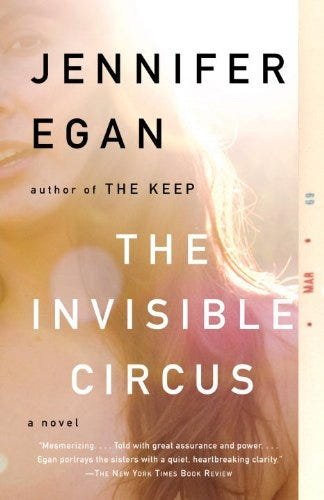
I first read The Invisible Circus in 1994. Since then, Jennifer Egan’s books have won many awards, including the Pulitzer and the National Book Critics Circle Award for Welcome to the Goon Squad. Egan’s later books may be revered by critics, but my favorite is her first, The Invisible Circus. It is a story in which I see my teenage self, for I, like the book’s narrator, lived in the Bay Area in my early teens.
As The Invisible Circus begins, it’s 1978 and Phoebe O’Connor has just graduated from high school. (In real life, I would have been a year younger.) In the fall, she is set to attend Berkeley. Phoebe, however, can’t imagine a collegiate life. Since her charismatic, troubled older sister Faith committed suicide when Phoebe was ten, Phoebe has been stuck. Now eighteen, the age Faith was when she killed herself, Phoebe feels she must understand what happened. Her remaining family—a brother and a mother (her father died of cancer)—are moving forward, but Phoebe knows she cannot until she makes sense of the past.
A chance meeting in Golden Gate Park with one of the hippies in Faith’s group of wild and alluring friends—the invisible circus—sends Phoebe on a trip to Europe, using postcards Faith has sent her as her guide. She follows the same path Faith took, with the ultimate destination being Italy, the site of Faith’s death. What she wants is to understand how Faith, who seemed afraid of nothing, could have chosen suicide.
Egan’s prose immerses you in Phoebe. She travels the places Faith traveled, and each locale is vividly seen through Phoebe’s eyes. Halfway through the book, in Munich, Phoebe finds her sister’s old boyfriend, Wolf. The Invisible Circus isn’t a love story, but Phoebe’s and Wolf’s relationship is mesmerizing to read. It is so charged because Wolf is not simply a man Phoebe desires, but one of the last living repositories of Faith, which makes their intimacy feel erotic, dangerous, and terribly sad. From there, as the two travel together, Phoebe moves closer to the truth she so desperately seeks.
My children are routinely horrified by the stories I tell of my teenage years. I moved to Marin County at 13 in 1973 and spent my junior high and first two years of high school there. The 1960s and 70s were a radical time in the Bay Area. In The Invisible Circus, Egan limns them impeccably. I didn’t have all of Phoebe’s adventures, but her Bay Area was mine. I will always feel I—and Phoebe—were lucky in that we both were only singed by the mesmerizing wildfire of that time and place. When I think about my teenage years, hitchhiking across the Golden Gate Bridge, wandering stoned through Golden Gate Park—I was never as wild as I was then—I often think about The Invisible Circus. It is a gorgeous wallop of a novel about grief, family, love, and the emotional and moral chaos of the 1970s.