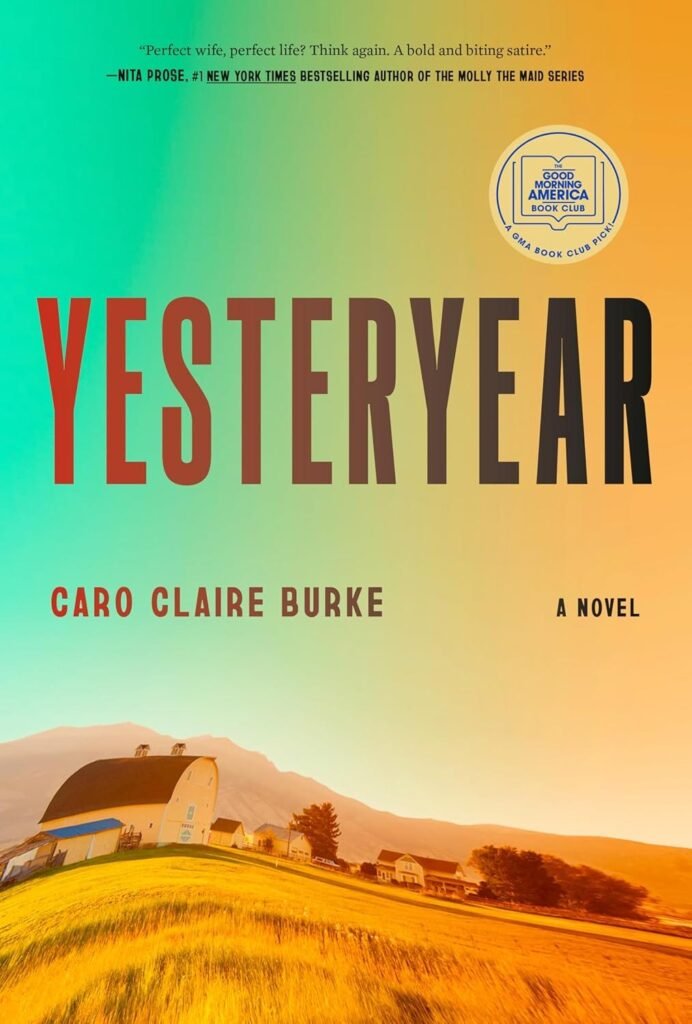
Yesteryear
I have tried to avoid spoilers here but this is a book that to know anything about it at all might diminish its twists. You have been warned.
Yesteryear is one of those buzz books that suddenly seems to be everywhere. It sucked me in immediately and, for most of it, I could not put it down. But as the book barreled toward its gonzo conclusion, it became less of a wow read and more of a wtf one.
The setup is terrific. Natalie, a trad wife influencer, has built a huge platform around a curated domestic life. She lives on a tucked-away Idaho farm with her husband and many children, posting perfectly lit shots of her perfectly faked life. In reality, her husband Caleb is a man-child, her kids are photo ops, and she damn sure uses pesticides on her fake hand-grown organic crops, which are actually grown by ranch workers. Her followers would be shocked to see the nannies, the modern appliances, and the rage holding the whole thing together.
Then, one morning, Natalie wakes up in what appears to be the early 1800s. There, her husband — a harder, meaner version of Caleb — expects her to do a shitload of work. She is freezing. She is exhausted. Her supposed children are strangers. Why has this happened? Is it real? Is it punishment? Delusion? Both Natalie and the reader have no idea.
For a while, that uncertainty works. Yesteryear is sarcastic, startling, and ridiculously readable. But the farther I read, the less the pieces held.
Natalie is the clearest problem. She is awful in every version of her life, which is not, by itself, a flaw. I’ve nothing against an unlikeable woman. Go forth, be horrible. But Natalie’s horribleness never really develops. It just keeps appearing.
In flashbacks, she is a pious and cruel scholarship student at Harvard, where she loathes her classmates, especially the women. She thinks nearly everyone is an idiot. Even Caleb, whom she meets and very quickly marries, seems to inspire less love than calculation. In the present, she barely tolerates her children, lies to almost everyone, and is horrific to her staff. In the 1800s, she is frantic, bratty, cruel, and maybe insane, maybe not.
At first, her contradictions are interesting. She hates motherhood but keeps having children. She hates the farm but insists on staying there. She disdains her husband but judges other women’s choices. She performs a life online that she plainly resents. I wanted to see what would happen when the performance collapsed. But the contradictions do not deepen. They repeat. Again and again, the book tells us that Natalie is hypocritical, cruel, delusional, and trapped in a life she claims to value. Okay. She is. And?
The Caleb thread should sharpen this, but it muddies it instead. Caleb is there in all three of Natalie’s lives: college, the present day, and the 1800s. In college and in the present, Natalie dislikes sex with him. Then, in the 1800s, when Caleb is at his most domineering and frightening, something shifts. That could be fascinating. It could also be horrifying. But the book never made me believe it knew what to do with the shift. I kept waiting for those sudden orgasms to mean something. They didn’t.
The book’s ideas have the same problem. Yesteryear raises questions about faith, gender, marriage, motherhood, labor, influencer culture, and the performance of feminine virtue online. It does not need to answer all of them neatly. Ambivalence can be powerful. But here, the ambiguity did not feel controlled. It felt poorly thought out.
And then there is the ending. Without getting into spoilers, it did not work for me. It did not make Natalie make more sense. It did not sharpen the book’s ideas. It did not make the earlier mess feel intentional. It felt like the close of a provocative setup the novel did not know how to resolve. Worse, it makes no sense.
I can see why Yesteryear has grabbed so much attention. It is readable, bitterly amusing, and full of ideas to talk about. But for me, it was too frustrating to satisfy. It could have been an incisive novel about the fantasy of domestic purity and the women who sell it and are crushed by it. Instead, it was a page-turner that fell apart. Even now, after giving it a lot of thought, I have very little idea what it ultimately wanted to say. It is a good time. I suspect it is not a good book.