The Woodsmoke Women’s Book of Spells
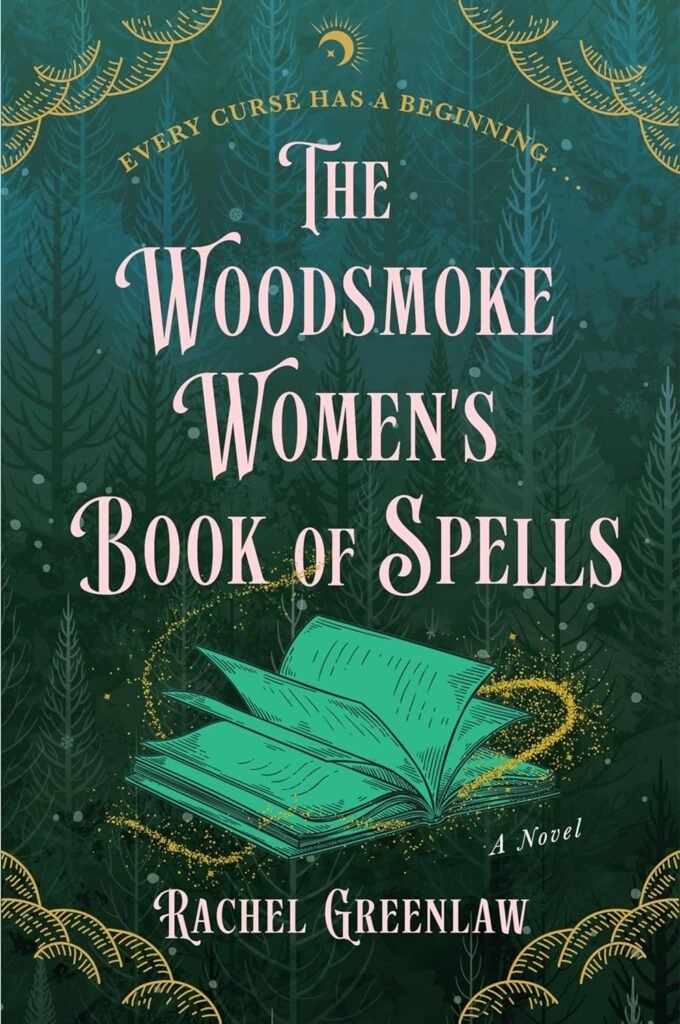
Rachel Greenlaw’s The Woodsmoke Women’s Book of Spells opens with intrigue but fizzles before it can fully cast its spell. I had high hopes—her previous novel, Compass and Blade, was a standout, and comparisons to Adrienne Young set my expectations even higher. But somewhere in the pages, the story begins to lose the thread, as if unsure whether to lean into its magic or unravel it.
Woodsmoke, nestled beneath brooding mountains, is both setting and character—a place that feels hostile in the way only small towns steeped in secrets can. The Morgan women, a dwindling line of witches, sit at the center of this story. Carrie Morgan returns after the death of her grandmother, Ivy, to claim her inheritance—a cottage and a store—and confront the legacy she’s spent years trying to outrun. Her mother remains a shadow in the narrative, having fled years ago, leaving the weight of their magic on Carrie’s shoulders. Ivy’s sister, Cora, remains in Woodsmoke, a prickly presence who casts spells for the townsfolk from the family’s ancient book, her power a lifeline as much as it is a burden.
Carrie, restless and rootless for the past decade, hopes this return might finally settle something inside her. But the town she left is the same town that remembers—most painfully through Jess, Carrie’s former best friend, now married to Tom, the man Carrie never quite stopped loving. What follows is a story thick with tensions that simmer rather than spark.
Then, of course, a man appears. A stranger arriving with the season’s first frost, Matthieu is more myth than man—a figure straight out of Woodsmoke lore, said to charm Morgan women only to vanish come spring. Carrie, predictably drawn to him, ignores Cora’s blunt warnings, letting herself get swept into his orbit. Jess, meanwhile, spirals into jealousy, convinced Carrie has come back to ruin her marriage.
The novel alternates between Carrie, Jess, and Cora’s perspectives—a structure that should deepen the narrative but instead exposes the limits of the characters. Carrie feels too passive, Jess too predictable, and Cora’s sharpness starts to grate. What begins as promising insight into their inner lives becomes a feedback loop, circling the same conflicts without much evolution.
The men—Matthieu, Tom, and Cora’s husband Howard—drift through the story like props. They exist to move plot points forward, but none are compelling enough to stand on their own. Whether this was a deliberate choice or not, it leaves them feeling hollow, their presence never quite resonating.
The novel plays with magic but never fully commits. It teases the idea that supernatural forces might shape events, only to pull back and suggest the real power lies in human frailty. Rather than a satisfying ambiguity, this indecision feels like hesitation, as though the story is afraid to follow through.
Still, there are whole swathes where Greenlaw’s talent shines. Her descriptions of Woodsmoke’s landscape are vivid, capturing the uneasy relationship between people and place. Early scenes bristle with possibility, and for a while, the novel hums with an undercurrent of tension that promises more than it delivers.
But as the story progresses, the relationships fail to deepen, and the plot struggles to hold its shape. What could have been a rich exploration of identity and legacy ends up feeling scattered. It’s not without charm, but it fades before it can make a lasting impression.
Greenlaw’s writing has undeniable flair, and The Woodsmoke Women’s Book of Spells shows glimpses of what could have been a far stronger novel. It just never quite finds its way.