
How the Marquess Was Won
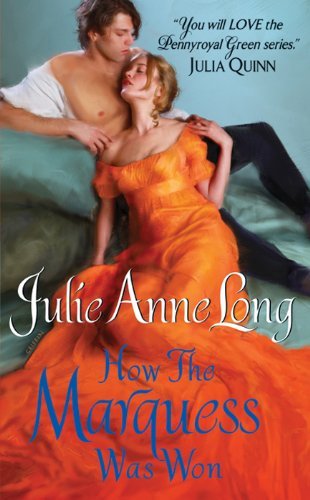
I liked this book. I liked it a lot. And yet…. The truth is, I’ve so loved the last two books in Ms. Long’s Pennyroyal Green series, I Kissed an Earl and What I Did for a Duke, that to like this book — just to like it and enjoy it as a good read — was a bummer. How the Marquess Was Won is, as I’d expect from Ms. Long, wildly well-written, peopled with complex characters, and willing to delve deeply into the nature of true love.
It isn’t, however, relentlessly compelling or compulsively re-readable. Nor is it — and this is part of my discontent — the tale of an Eversea or a Redmond, the two families whose lives and loves have been chronicled in the series’ first five books.
The heroine of How the Marquess Was Won is Miss Phoebe Vale, a forthright young woman who is a teacher at Miss Marietta Endicott’s Academy for Girls. Phoebe, born in the slums of London, has secured her place in life by dint of will and intelligence. At twenty-two, she’s unmarried and feels rather uncomfortably on the proverbial shelf. Phoebe has a vibrant, enthusiastic imagination — fueled in part by the broadsheets she loves. She knows that while she may be lowly born, her aspirations are as valid as anyone’s. She appreciates the stability Endicott’s Academy has brought her — she arrived there at age ten, swept off the streets of Seven Dials by a mysterious benefactor — but she wants more. As the book begins, Phoebe is contemplating saying yes to two opportunities, one which would take her to Africa to teach, and the other, a short-term affair (just two days), which entails being a chaperone to former student Lisbeth Redmond, the niece of Fanchette and Isaiah Redmond.
Lisbeth, is at twenty, a diamond of the first, albeit shallow, water. She will make the perfect wife for any lord and, the hero, Julian Spenser, Marquess Dryden, is known for his perfection. Dryden, dubbed by the scandal sheets who track his every move as “Lord Ice,” has spent years ruthlessly, carefully, and flawlessly amassing his fame and fortune. His father was a reprobate who gambled away the family’s wealth and property. Julian has gotten it all back, whilst earning the slavish devotion of the ton – all but one last piece of land. That bit of English countryside, currently owned by Isaiah Redmond, will be Julian’s when he marries the lovely Lisbeth.
The plot here is well-executed and as conventional as it seems. Julian, as full of himself as any hero could be without being completely intolerable, falls for Phoebe and yet can’t conceive of her as more than a mistress. Phoebe, of course, refuses to settle for such a lessened life. Julian courts the elegantly cruel Lisbeth even as he works ardently to get Phoebe in his bed. A happy ending for the lovers seems not possible, and yet we readers know that love will find its way, helped along by Phoebe’s formidable feline Charybdis.
I wasn’t bothered by the routine plot. Ms. Long is justly known for creating undeniable individuals and she does so in How the Marquess Was Won (although in this book, the portrayals of the ladies and lords buzzing about the lovers are unusually flat). But the leads, Phoebe and Julian, are nuanced characters. As in all of the Pennyroyal Green books, Ms. Long uncovers, layer by layer, the true selves underneath the images her protagonists present to the world. Love, in these books, is antithetical to the social definition — the class definition — of perfection. Julian and Phoebe are, by the novel’s end, tangibly real to each other and to the grateful reader.
And yet….
Unlike Alex, the hero of What I Did for a Duke or Asher, the hero of I Kissed an Earl, Julian is delineated by others’ reactions. He is defined by society rather than by his own actions. The Marquess, when compared to other heroes in this series, is just not as interesting a man. I found his redemption to be almost rote and I finished the novel unsure about his ability to live with and love Phoebe on their terms.
I missed terribly the continuation of the tale of the Everseas and Redmonds. Ms. Long has deliberately placed — and paced — tidbits of information, clues really, in the earlier books in the series. Those who’ve read the previous books are invested in the storylines winding through lives of the two families. None of these narratives is explored in this book. It’s as if, after having led her readers through a marvelous maze, Ms. Long abandoned her wonderfully labyrinthine tale.
Let me repeat myself. I liked this book a lot. Ms. Long’s fluency is extraordinary. In How the Marquess Was Won, she pens scene after scene where the words conjure worlds vivid and alive. She’s a witty writer with a seemingly unlimited frame of reference. This book made me laugh. Her lovers touch each other sensually and in ways replete with romance. I took pleasure in every moment I spent reading this novel.
It’s a good book; just not as great as I hoped the next Pennyroyal Green would be.