A Beginner’s Guide to Rakes
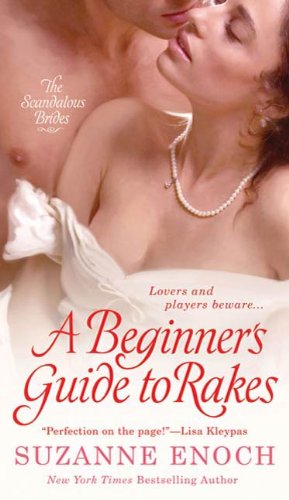
In Ms. Enoch’s latest, The Beginner’s Guide to Rakes, the first paragraph reads: “Very few things in the world could make Oliver Warren, the Marquis of Haybury, flinch. He could count those things on one hand, in fact. The yowling of small children. The squeak of rusted metal. And the mention of that name.”
She had me at yowling.
That name is Diane Benchley. Two years ago, in Vienna, when Diane had just been widowed and made penniless, Oliver and she shared an intensely passionate two weeks which ended when Oliver fled her bed without a word of explanation. Now, Diane, Lady Cameron, has returned to London where she aims to open a gentleman’s club in the only thing her gambling addicted husband left her, a London mansion called Adam House. In order to do so, however, she needs cash: Cash which she plans to borrow — actually demand by blackmail — from Oliver.
Oliver is a man accustomed to getting his own way. When Diane gives him a choice between being banned from every gaming establishment in London (she has a signed statement saying Oliver cheated in a game of cards) or lending her five thousand pounds, Oliver agrees to loan her the money. He does so with two goals in mind. First, he wants to prove to himself he was right to cut and run two years ago. Second, he plans get the proverbial upper hand with Diane. No one, and especially not a woman, is going to tell him what to do.
There are many joys to be found in the pages of this book. It’s wonderfully well-written. In fact, The Beginner’s Guide to Rakes has one of the best single lines I’ve ever read in a romance. (It’s the last line of chapter six.) Ms. Enoch uses language precisely and elegantly; her words are delightful in and of themselves and propel the plot perfectly. Her dialogue is witty and clear and showcases the ways Oliver and Diane struggle for control in their relationship and of their feelings for one another.
The setting is also a treat. Ms. Enoch makes the Tantalus Club, its workers, and patrons vividly real. Diane has a soft spot for women society has cast out and her (almost) all-female staff is well differentiated. The men who seek membership in the club — wealthy lords who may or may not have money to burn — are also clearly delineated. Some of the men are awful, but others aren’t – and Ms. Enoch adroitly avoids the class stereotypes often found in Regency romance.
The love story is engaging as well. Ms. Enoch spins out her lovers’ tale slowly. It’s not until almost the end of the book the reader learns why Oliver ran “like a scalded dog” from Diane in Vienna. Neither Oliver or Diane truly trusts the other, for good reason, and yet they are drawn to each another like lodestones. The sex the two share is passionate but it doesn’t create love between them. Oliver and Diane can’t find any sort of happy ending together until each sees the other as an essential equal and for both, taking that step is exceedingly hard to do.
Moreover, there’s a fine plot in the novel. Diane is challenged for the ownership of Adam House by her late husband’s prig of a brother, Anthony, the current Duke of Cameron. Oliver, Diane, and her employees all scheme and plan to keep Anthony’s claims at bay. And though the dénouement of tale is a bit over the top, it works in Ms. Enoch’s wry hands.
I enjoyed this book and would have given it a DIK except for three things. First – and this is a picayune criticism but it still irked me — the title of the book hasn’t a whit of relevance to the book’s story. Diane is no beginner, she’s not writing or reading a guide, and Oliver isn’t a rake. Second, the middle of the book drags compared to its first and last thirds. Third, Diane and Oliver are pragmatists who use a condom the first time they make love and yet every other time the two have intercourse, Oliver comes inside her and no one mentions the possibility of pregnancy. It makes little sense. Diane and Oliver are detailed planners in every aspect of their lives and yet the very real chance that unwed Diane could get pregnant by wanting to stay unwed Oliver never seems to occur to either of them.
These three wrongs, however, are outweighed by all that’s right in the book. The Beginner’s Guide to Rakes is a well-written, well-plotted, witty novel. It looks to be the first of a new series called The Scandalous Brides. I look forward to reading the next entry. If it’s as good as The Beginner’s Guide to Rakes, I’ll be a happy reader. I might even yowl with pleasure.