Scandal in Scotland
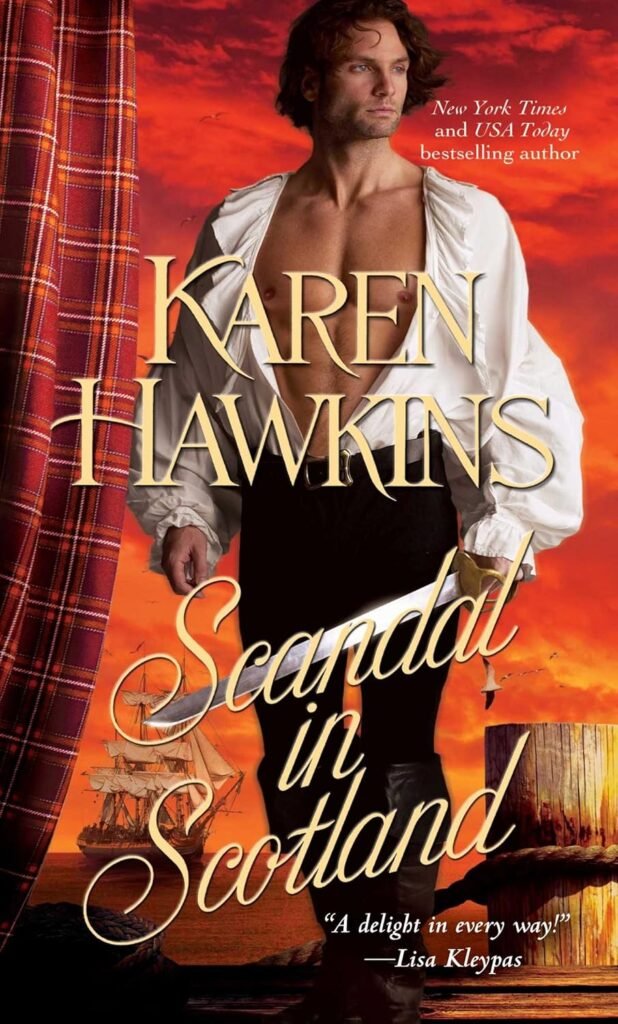
Scandal in Scotland is the second in a series of books by Karen Hawkins centered on an object called the Hurst Amulet. An amulet is a charm, usually worn about the neck, which wards off evil. In Scandal in Scotland, our heroine and hero are chasing after an onyx box that does not have any charms or jewelry in it at all.
The onyx box is consistently referred to as an ancient artifact – an artifact being something created by someone for some practical purpose. Perhaps later in the Hurst Amulet series the amulet will appear and the reason for the name of the series will become clear. I’ll never know. This book was such a bland, predictable read; I’ve no interest in the rest of the series.
The book – and each chapter – begins with a letter from one Hurst family member to another. (I disliked the letters — they interrupted the narrative, and given that I hadn’t read the first book, several of them made little sense.) In the first chapter, the letter is from imprisoned explorer and Egyptologist Michael Hurst to his brother sea captain William Hurst. Michael is being held by captors who want the amulet/artifact/box. The Hurst brothers’ sister Mary apparently got the amulet/artifact/box in the first book in the series and handed it off to William. William plans to take it to Egypt and give it to the as yet unidentified bad guys holding Michael. William brings the amulet/artifact/box to his ship and is readying to set sail when, in his cabin, he encounters the only woman he’s ever loved, the famed actress Marcail Beauchamp.
William and Marcail were in love eight years ago when, so William believes, she dumped him for a titled lord who could better keep her in high style. Given that Marcail is the heroine of this story, the reader understands in an instant what William never has: The real reason Marcail left him had nothing to do with money and everything with her being noble. Marcail is so perfect a heroine, she’s uninteresting. She’s incredibly beautiful – violet eyed, voluptuous, skin like silk, blah, blah, blah. She’s also the most talented actress to ever tread the British Isles’ boards, has a voice that could seduce the Pope, gives up everything that matters to her to protect her family, and is a supporter of gay rights. Marcail has come to William’s cabin to get the amulet/artifact/box from him. She is being blackmailed and her blackmailer has demanded the amulet/artifact/box. If she doesn’t hand it over, the blackmailer will make her true identity public, and even though she’s the best actress in England, it would ruin her family’s reputation to be known to be related to her.
When William sees Marcail, he is again overwhelmed by his desire for her, so much so that he has to force himself to look away from her “to break the spell of her beauty.” He, however, is still furious at her for breaking his heart and making him distrust all women, so he tells her he’d never lift a finger to help her. She then drugs him, steals the amulet/artifact/box and runs off feeling guilty for doing such a terrible thing to William whom, unshockingly, she still loves.
I don’t know why Marcail loves William. He bored me. He’s a cardboard character — he has dark blue eyes surrounded by a sensuous sweep of lashes dark as coal, a jaw that makes other men’s faces look weak, blah, blah, blah. He doesn’t seem to be the sharpest knife in the drawer – I couldn’t believe he was so clueless about the “true” Marcail who is so obviously self-sacrificingly perfect. It also irritated me that he was so critical of her for being someone’s mistress (she’s not really, but he thinks she is) given that she slept with him when they first met. I thought that was rather odd, actually. When she met him, she was a virgin and, despite being an actress, from an upper-class family. It would have been a big deal for someone like her to give up her maidenhood outside of marriage, but, in this book, it’s unremarked upon. Ever since she left him, he has thought of her as little more than a high-priced whore, although of course she’s never slept with another man. His double standard is galling.
This book has everything your wallpaper historical romance often has: Unthreatening danger, bouncy sex in a carriage, and sagacious, ribald elderly ladies. William chases down Marcail, they realize they should work together to defeat the bad guys, and, after the set number of scenes where they both long to be together but are held back by misunderstandings from their past, they cast off their clothes, open their hearts and, having passed the responsibility for the amulet/artifact/box to the next Hurst, presumably live happily ever after.
As I turned each page of this book, I had my expectations met on every page. After the first few chapters, I was turning the pages very quickly. The more I read, the less interested I became. While it’s true historical romance is a genre in which novels often follow a set of conventions – two people meet, encounter obstacles on their path to true love, and by the story’s conclusion, have found happiness together – in well-written novels, those conventions are explored in ways that are fresh and reimagined; the characters are multifaceted and complex. In Scandal in Scotland, the story is stale and leads one-dimensional.
To be fair, Scandal in Scotland isn’t a bad book. Ms. Hawkins has written several other books I’ve enjoyed (I love An Affair to Remember.) She’s a technically strong writer and she does a good job of creating a believable sense of place. But in this book, those skills are lost in the banality of her “lovers with a second chance at love” tale. So, though it means I’ll never know the truth about the Hurst amulet/artifact/box, I’m not reading another book in this series.