Eleven Scandals to Start to Win a Duke’s Heart
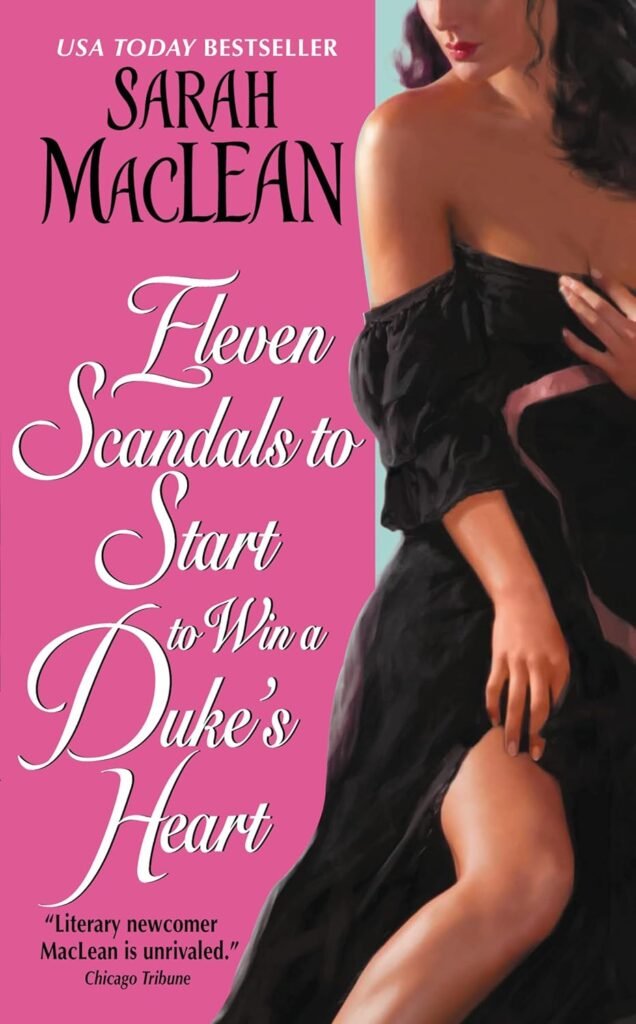
Like Ms. MacLean’s series, this review is by the numbers. Here are eleven reasons for my disinterest in Eleven Scandals to Start to Win a Duke’s Heart .
1)The title is overwrought. Ms. Maclean’s trio of linked books is the Love by Numbers trilogy, and the titles all contain a little rhyme. I found this one to be particularly odd. I rarely think of scandals as something one starts. Every time, I picked up the book, I lapsed into thoughts of other titular options. Eleven Secrets to Tell to Marry Very Well. Eleven Scenes to Throw to Catch a Duke as a Beau. Eleven Kisses to Bestow to Become a Noble’s Ho. I suspect had the book been more engaging, I wouldn’t have been so distracted by its silly name.
2)The writing is breathless to the point of annoyance. Ms. MacLean relies on italics and/or sentence fragments to show her characters’ drama-laden inner thoughts. Paragraphs like this one made me wince.
“No. They were in a public place. He had to stop. She deserved better. They had to stop. Before he ruined her.”
3)The book is written with the assumption the reader has read the two novels that proceed it. I hadn’t and thus had a hard time following the plot and the lives of many of the characters.
4)The heroine, Juliana Fiori, the daughter of a dead Italian merchant and a disgraced bitchy English aristocrat, is so stereotypically Italian she’s almost a caricature. She’s tempestuous, wild, impulsive, and voluble. She, twice, knees a man in his inguine. She is, just by being, a scandal. Juliana didn’t seem real to me — I felt as though she were symbolic, a representation of passion, rather than a genuine woman.
5)The hero, Simon Pearson, the Duke of Leighton, is remarkably unlikeable. He’s called “the Duke of Disdain” because he arrogantly views everyone as below him. He is “cold and impassive,” “stiff and proper and all about the title,” and “sneering.” He cares more for his family’s reputation than his family. He’s manipulative, selfish, and haughty…and not in an appealing way.
6)Simon is at least fifteen years older than Juliana and yet behaves as immaturely as she does. His actions are inconsistent, self-indulgent, and even petty. He represents the ton at its most conservative, but, really, he behaves as though he’s an undisciplined, randy youth.
7)For much of the book Simon publically treats Juliana as beneath him in society while privately longing for her to be beneath him in bed. He seduces her, and allows her to seduce him, despite his being engaged to another nice young woman. He, who cherishes reputation above all, is overly willing to ruin Juliana’s for the sake of his desire. He isn’t sexy, he’s demeaning.
8)Early in the book, Juliana challenges Simon to a confusing wager. She tells him that she can prove that “not even a frigid duke can live without heat.” She asks for two weeks to — and this is where I became confused. Two weeks to make Simon passionate? Two weeks to make him tell her she’s right? Two weeks to ruin his reputation? By the end of the novel, it still wasn’t clear to me what the wager was to have accomplished. Given that it’s a major plot point in the book, it was irksome it wasn’t clearer.
9)The two older mothers in the book, Simon’s and Juliana’s, are awful women. Both Simon and Juliana have serious emotional limitations caused by maternal neglect and dislike. For most of the book, the damage done by these maternal Cruellas influences the choices Simon and Juliana make. Then, suddenly, the two are unfettered by these mean motherly limits. The change in both characters was sudden and profound and, to me, unbelievable.
10)The end of the book has a number of implausible scenes. Simon and Juliana behave in uncharacteristic ways. I understand the reader is to believe the two have been remade by love, but, here again, I didn’t buy it. To me, the transformative power of love, to be viable, needs to alter the heroine and hero in ways that are in keeping with the characters they are. I don’t trust happy endings where the lovers become completely new people with sparkly new values. In this book, both Simon and Juliana change dramatically and Simon, in particular, is unrecognizable as the man he was prior to meeting Juliana.
11)Simon is the main male in this book, but, not, in behavior, the hero. Even at the end of the book, he makes choices that are hurtful and self-serving. His actions seem even less heroic compared to the story’s true male hero – if one defines a hero as he who acts bravely, ethically, and nobly – Juliana’s half brother Nick St. John. Nick is a wonderful man. In contrast to him, Simon seems an even bigger ass. I haven’t read Nick’s love story, told in the middle book of the trilogy, Ten Ways to be Adored when Landing a Lord, but I feel sure I’d like that book better than this one.
So, there’s my list. I didn’t enjoy this book. The hero was unpleasant; the heroine, illusory; the ending, suspect. For me, this novel’s title should have been Eleven Ways to Write a Romance that Doesn’t Delight.