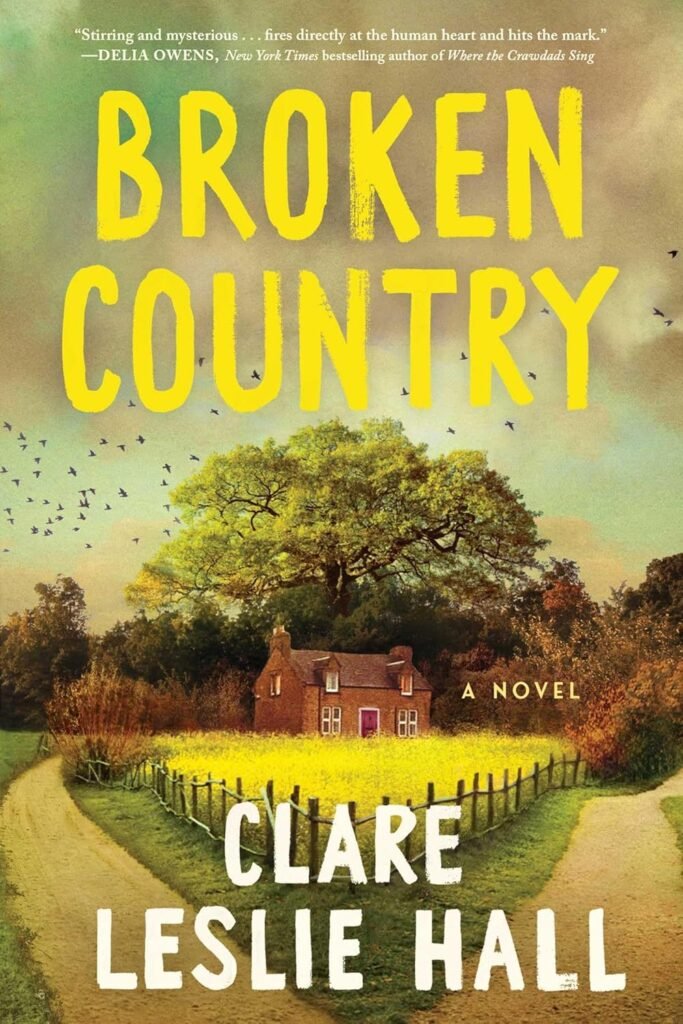
Broken Country
At first, Broken Country sets the stage for a familiar kind of novel—a love triangle stretched across decades, a quiet life disrupted by the return of an old flame, an English countryside thick with longing and regret. But then, just a few pages in, everything shifts. A trial. A man Beth loves, standing in the dock, accused of murder. The novel guards its secrets with deliberate restraint, revealing them in slow, careful increments. Some will admire the control; others will wish Hall would just get on with it.
There are, in fact, two mysteries at the heart of this novel. The first is the murder trial—who is dead, and who did it? The second is quieter but cuts deeper: what happened to Bobby, Beth and Frank’s son? The trial is a whodunnit, an unraveling of events that leads to a courtroom reckoning. But Bobby’s story is a tragedy, its truth creeping in at the edges before finally breaking the reader apart. One mystery shocks; the other wounds.
The novel moves between 1955 and 1968, tracing Beth’s entanglements with Frank, her steady, practical husband, and Gabriel Wolfe, the golden boy she once adored. In the present, Beth and Frank live on a farm in Hemston, Dorset, alongside Frank’s brother, Jimmy, whose drinking makes him a live wire. Then a stray dog arrives, attacks their sheep, and is shot. A boy, Leo, comes running, inconsolable. It was his pet. His father? Gabriel Wolfe, newly divorced, now a celebrated novelist, back in town after years away.
And with that, the past starts pressing in. Beth, still grieving Bobby, sees Leo’s pain and gifts him a puppy. She lingers at Meadowlands, Gabriel’s family estate. Frank notices. And waits.
The 1955 timeline takes us back to the beginning—to the summer Beth and Gabriel first fell in love. She was young, dreamy, lost in the pages of Austen and Brontë. Gabriel was dazzling, and she let herself believe in the kind of love that rewrites a life. But then he left for Oxford, something between them cracked, and Beth, in time, chose Frank.
But Broken Country is not a novel about choosing between the past and the present. Gabriel, her first love, shaped her. So did Frank, the man who built a life with her after Gabriel was gone. Neither love eclipses the other. Both define her. The woman she is now exists because of them both. The novel refuses to rush this reckoning, keeping the love triangle unresolved until its final pages.
And all the while, there is the trial. We know from the start that someone—Frank? Gabriel? Jimmy?—is accused of murder. What we do not know is how everything unraveled. Hall withholds her answers with precision, her clues measured and patient. Some readers will revel in the slow unfurling of truth. Others will shake the book, demanding it give up its secrets faster.
But when the truth comes, it lands with weight and finality.
I struggled a bit with the resolution, but I still liked it. The ending is not unsettling, nor is it unsatisfying, but it resists the kind of comfort some readers might want. Hall does not offer easy conclusions, but she delivers an ending that is entirely right for the story she has told.
Hall’s writing is elegant and unhurried, not just in style but in the way she builds lives on the page. She does not bend to the reader’s need for catharsis or closure; instead, she asks us to sit with the choices her characters have made, to reckon with the things they cannot take back. The novel does not grip you by the throat—it settles into your bones. If you are looking for a story that unfolds with patience, depth, and emotional complexity, Broken Country is one worth reading.