
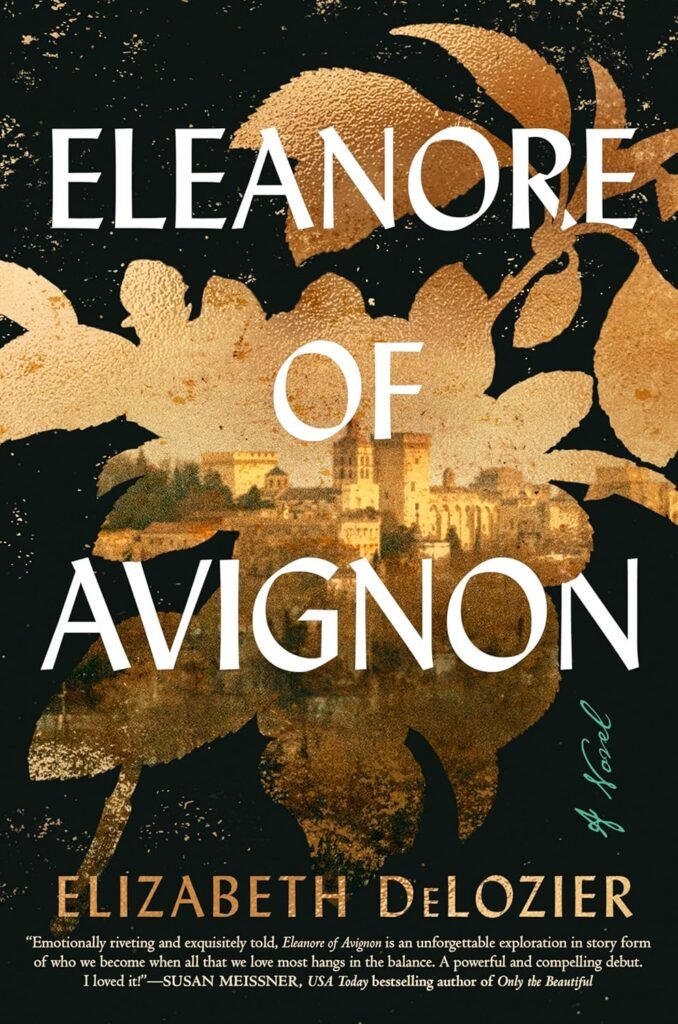
Eleanore of Avignon
As a child, I’d clasp the hand of another on the playground, skip in a circle, and sing
Ring-a-ring-a-roses,
A pocket full of posies,
Ashes! Ashes!
We all fall down.
This rhyme is famously said to be about the Black Death (although folklorists doubt that it existed prior to the 18th century.) In human history, few events have been more transformative than the Plague of the 14th century. It is believed to have killed almost half of Europe’s population and remade Western society.
The Plague first arrived in Europe in 1347, the year in which DeLozier’s extraordinary first novel Eleanore of Avignon is set. The novel begins in November of that year, on the outskirts of Avignon, where Eleanore, our fictional titular lead, is searching for medicinal herbs: comfrey for Anes’s swollen knees, fennel for the baker’s fussy baby, pennyroyal to keep the fleas at bay. Eleanore is an herbalist, a gifted one. Her mother, now dead from childbirth, was the city’s midwife and, some say, witch. Eleanore has inherited both her mother’s mantle and, Eleanore’s most prized possession, her book of herbal healing: Dog-eared and water-stained, it contains all her remedies: medicines to start contractions when a baby will not come, for toothaches and gripe, to soothe winter coughs and ease swelling in painful joints.
As Eleanore walks back to the home she shares with her sister, Margot, her father, and their maid, Anes, she hears the usual sounds of stone masons shouting and of hammer blows. This is the time of the Avignon Papacy, the seven decades in which seven popes resided in Avignon rather than in Rome. The current pope, Clement VI, a man known for his love of luxury, is building a new palace fit for a king. And though his reign over the church is relatively unchallenged, the rule of the land is contested. Eleanore and her sister Margot support Queen Joanna, Queen of Naples and Countess of Provence, who soon will travel to Avignon to stand trial for the murder of her first husband, Andreas.
A few days later, as Eleanore is again out hunting for herbs–she finds a rare bounty of hawthorn berries (The fruit is cleansing and acidic; it decreases swelling and produces copious urine in someone with too much water in their body.)–she encounters a giant of a man. He asks her for the berries–he is, he says, a physician and he needs them for a patient. He is at first startled at Eleanore’s knowledge of the plant’s powers. After speaking with her, however, he is impressed and asks if she’ll accompany him to his laboratory and show him how to make her mother’s hawthorn tonic which he hopes will help his patient.
This doctor is no ordinary practitioner–he is none other than Guy de Chauliac, the pope’s personal physician and perhaps the most gifted surgeon in Europe. Though Eleanore is terrified, she goes with him and makes a tonic for the ill pope. Her tincture is effective and soon she is working with Guigo, as he is called, in his laboratory, learning the craft of medicine. Eleanore has never been happier–the two are a great partnership and she revels in being taken seriously as a healer and in all that she is learning.
Then, Clement VI summons the two to his quarters and tells them that the pestilence Eleanore has heard rumors about has arrived in Marseilles. The Pope tasks Guigo and Eleanore with finding a cure–they know it is simply a matter of time before the Black Death comes to Avignon.
By February,
Ash from the bonfires hangs thick in the air, casting the buildings in queer yellow light and catching in our hair like snow. Avignon’s bells no longer ring. The only sounds in the city are the rattle of the corpse carts and the calls of the crass country peasants who push them to the overflowing cemeteries: “Bring out your dead! Bring out your dead!”
Twenty thousand Avignonese have perished.
Everywhere, there are whispers of blame. In Avignon, as in much of Europe, many blame the Jews for the Black Death. Others, wrapped in the robes of the church, blame the sins of the people and speak of witches and necromancers. It is a terrifying time. Each day, Eleanore sees those she knows and cares for die and, despite the Pope’s assertion that the work the Guigo and Eleanore are doing–Clement VI lifted the Church’s ban on autopsies so that de Chauliac could study the dead to better understand the disease–is blessed, there are priests in the town who wish her burned at the stake.
Eleanore of Avignon is superb historical fiction. I can scarcely credit that this is a first novel. Its context reflects our own times but never feels like a veiled parable. I was astounded at the barbarity and brilliance of the medical practices DeLozier presents in great detail and at the wisdom and stupidity of those who tried to stem the endless horrors of the Black Death. But the wonders of this book aren’t limited to its outstanding presentation of history–this is also a marvelous tale.
Eleanore’s story–the book is told in first person–is absorbing. Though she is literally trying to save the world, she is also trying to make sense of it. She deeply loves her twin, but Margot is also a frustration–for her sister, Eleanore’s ambitions are dangerous and threaten Margot’s own. As she and Guido work with others in Avignon to try to heal and to care for the some many sick and dying, Eleanore is drawn to David, a young Jewish medical apprentice though such relationships are forbidden. As more die, every choice Eleanore makes could mean the difference between life and death, not just for her, but for those she loves and those she tends to. I was riveted by her.
As a child, I was fascinated by the big questions: Can one person make a difference? Does love win? How does one defeat evil? In Eleanore of Avignon, these answers to these are plausible because they are ensconced in a clearly delineated time and place. They are potent because Eleanore, fiercely devoted and willing to risk everything, is a narrator of the highest order. I can’t recommend her story highly enough.