
Famous Last Words
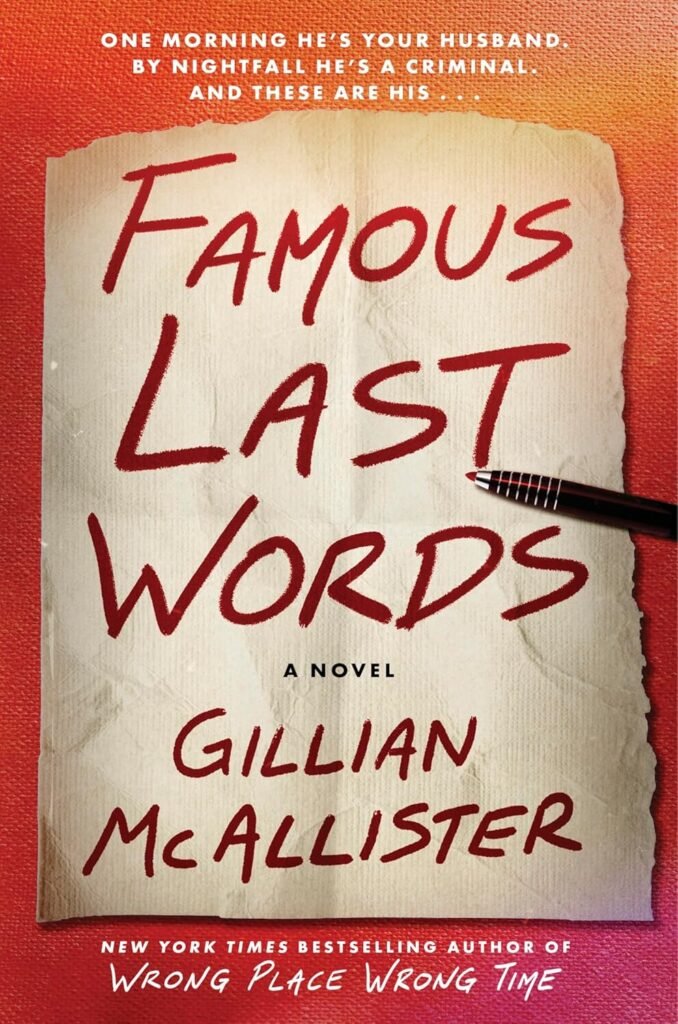
Gillian McAllister’s Famous Last Words doesn’t start with a murder, a car chase, or an anonymous text—it starts with a husband who simply isn’t where he’s supposed to be. That’s all it takes for McAllister to unravel a marriage, a career, and a life in real time. This isn’t a thriller that relies on cheap tricks or high body counts to keep you hooked. Instead, it thrives on an insidious kind of tension—the kind that makes you second-guess everything, including your own instincts. At its core, it’s about trust, betrayal, and—somewhat surprisingly—love.
The novel opens with Camilla (Cam), a literary agent and new mother, returning to work after maternity leave. It should be an ordinary milestone, one her husband, Luke, should be there to support. Instead, she finds a note—just ambiguous enough to be troubling but not clear enough to explain anything. Minutes later, the police arrive. Luke isn’t missing. He’s the gunman in a hostage crisis unfolding across London. And just like that, Cam’s life detonates.
McAllister structures the novel in three acts, each with its own rhythm and weight. The first is pure adrenaline, a masterclass in controlled chaos. Cam’s world unravels at breakneck speed, and McAllister doesn’t give either her or the reader room to breathe. The unanswered texts, the eerie normalcy of her morning before the news broke, the creeping horror that she might not have truly known Luke at all—every moment pulses with dread.
Then comes the second act, where the novel shifts from external catastrophe to internal reckoning. The siege is over, but Cam is still trapped—this time, in the aftermath. She pieces together what happened alongside hostage negotiator Niall, a man undone by that same day. A single misstep cost him his career, his marriage, and any semblance of peace. McAllister lets ambiguity fester. Was Luke completely not who Cam thought he was? Is Niall the solution to Cam’s questions or is he something far darker? The reader doesn’t know—every action revealed could have any number of explanations.
The final act is where McAllister’s skill truly shines. Every breadcrumb laid in the early pages leads to a conclusion that is as shocking as it is inevitable. There’s no final-hour gimmick, no twist for the sake of a twist. It all makes sense—sometimes, painfully so.
The characters in Famous Last Words are riveting not because they’re likable, but because they’re real. Cam isn’t a plucky heroine or a tragic victim—she’s messy, stubborn, and fully human. Her love of books—her tendency to escape into fiction as a way to process the world—will make readers of genre fiction happy. And yet, her desire to constantly escape into fun fiction makes her, at times, unable to do what the reader sees she needs to. It’s an astute character choice, making her both relatable and, at moments, frustrating in the best way.
McAllister writes with precision and care. Every moment in this novel matters, every choice is deliberate. And, wow, is it a page-turner. I clocked the central reveal about halfway through, but it didn’t dull the impact—instead, it deepened it. The novel’s emotional truth never wavers, even when some of its more dramatic turns stretch plausibility.
If you’re going to read it—and you absolutely should—clear your schedule. McAllister doesn’t just tell a story. She tightens the screws until there’s nowhere left to turn.