
It Takes a Thief
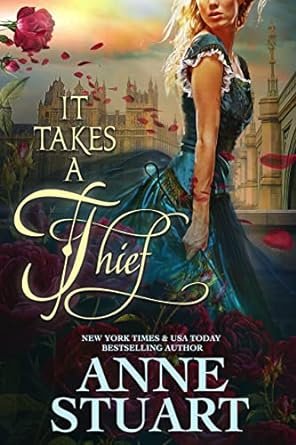
I have a soft spot for Anne Stuart’s books. When she’s at her best, her romances are a masterclass in dark, gripping romance, her heroes are morally iffy and complex and, whoa, she can write sexual tension and release to die for. Which is why It Takes a Thief left me sighing, not in delight but in disappointment. It has all the trappings of a Stuart classic—a brooding antihero, a feisty heroine, and a shadowy criminal underworld—but these trappings are obscured by an annoying heroine, a dogmatic hero, and a very tired plot.
Our heroine, Emma Louise Manchester, is attending a hanging of ten at Newgate. She is there with her tiresome fiancee, a man she thinks is an idiot–her brother arranged the match to pay off his gambling debts–and she’s resigned herself that the spectacular life she envisioned for herself when young–we are told again and again she’s really meant to be a pirate, whatever that means–is never going to happen. However, when the hanging goes wrong–two of the those in the noose are thrillingly rescued–she spies her long lost step brother Ben Crawford, now known as Nick the Butcher, the infamous leader of the criminal Beggar’s Ken. Once banished from their family home, Ben has reinvented himself as the ruler of London’s underbelly.
Emma, having glimpsed Ben again, rather unbelievably abandons all pretense of decorum to inveigle her way into his life. He was her champion in an unhappy childhood and she must, simply must, see him again. She chases him down to his criminal fiefdom where he tries very hard to convince her to scurry back to her genteel life. Emma, though, isn’t having it and before you can say only in wallpaper historical romance she’s regularly hanging out in the Ken and desperately trying to get up to no good.
This relentless pursuit of Ben is, I believe, supposed to be daring and passionate, but, instead, is childish. She is both stupendously naive and artlessly seductive, a combination Stuart doesn’t quite pull off. Add to that Ben’s tortured resistance to her charms—especially his baffling belief that Emma’s fiancé is somehow a better option than he is—and you end up with a dull story whose manufactured angst plays as farce. For what seems like eons, Emma stomps around loving Ben then hating Ben for not loving her and Ben, who has always loved Emma–this is rather icky, given that they grew up together and she was eleven when he last saw her–stomps around insisting that he’s not for her because he’s a bad man. Spare me.
I was hoping that there would at least be hot sex. Instead, the spark between the two never really ignites—a surprise in a Stuart romance, where the heat and tension between characters are usually scorching enough to leave the reader needing an ice bath. The book’s love scenes seem recycled from older works. Worse, every single time anything happens between the two–and this is true almost until the conclusion (which is followed by a relentlessly sappy baby-filled epilogue)–one of them immediately behaves badly. I’m never a fan of the I banged you but I’m still not good enough for you ethos in a romance and here, it is especially egregious.
And while I usually love secondary romances–they’ve become sadly thin on the ground in romance–this novel’s other lovers are also frustrating. Though I actually liked both characters far better than Nick and Emma–Molly O’Hanlon, the iron-willed caretaker of the Beggar’s Ken, and Thomas Campion, Nick’s right hand man and confidant–they too wasted pages and pages with stupid reasons why they couldn’t be together. It is true that Molly’s backstory—one of tragedy and resilience—is heartbreaking and this does give her love story with Thomas a depth that Emma and Ben’s tale lacks. But, at some point, a romance reader just wants a fricking romance and this book takes far too long to deliver one for either of its pairs of lovers.
It Takes a Thief is missing the heat and the moral ambiguity that makes books like Reckless or Black Ice stories I read again and again. It’s one of Stuart’s weaker efforts although readers who want comfortable and safe leads may enjoy it more than her edgier books. I, however, longed for Nick to be darker, Emma to be edgier, and for their love story to be more sharp and uncompromising. I also wanted a plot whose contours didn’t feel ordained from page one. Stuart can be brilliant but here, it’s just not happening.