Left of Forever
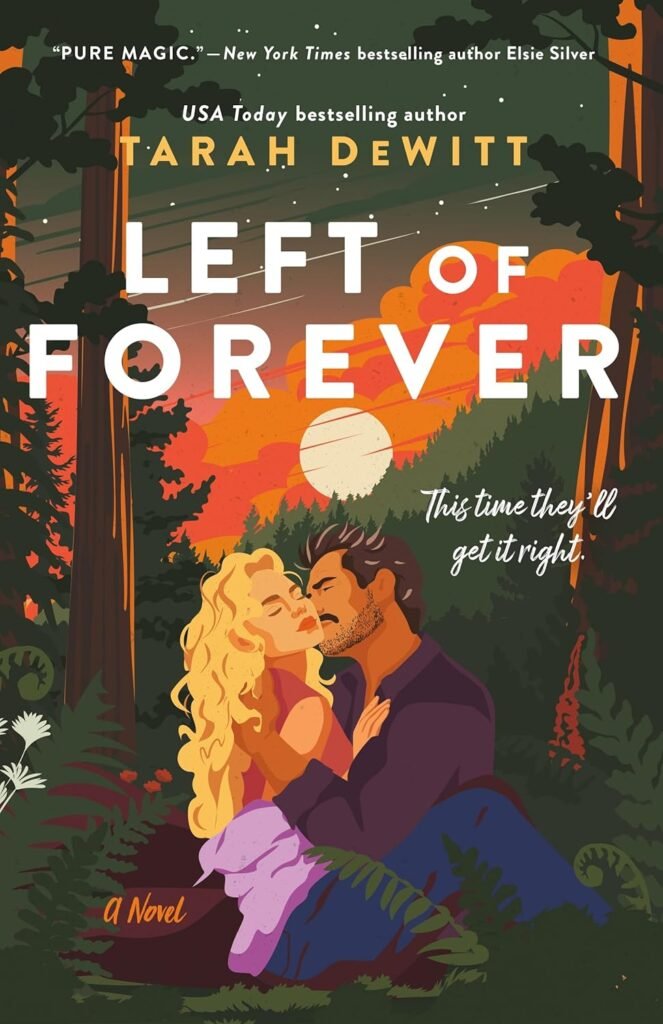
Do you feel you’ve missed out in life by not being a marriage counselor? Do you long to spend hours of time in the company of two 30 somethings with an endless penchant for self-analysis? And, most importantly, are you jonesing for a hero and a hero who are so damn perfect they make Neil Patrick Harris and his husband (#relationshipgoals) look like Kanye and Bianca (ugh). Yes? Great! Left of Forever is for YOU!
Wren and Ellis Byrd–they live in the tiny Oregon haven of Spunes where an unusual number of citizens have funky names–have been divorced for five years. She’s a warm, emotionally open baker whom I’m pretty sure is sparkly enough to power my laptop; he’s the strong, silent type–a firefighter who shoulders responsibility for everyone and is well-known for his pithy–read lack of–remarks. They’ve done a good job raising their son (he is unscathed by their divorce), but they’re still caught in the emotional tangle of a relationship that never truly ended.
Initially, the two have a re-meet cute of sorts. While Ellis is away fighting a wildfire, he and Wren inadvertently begin exchanging anonymous letters. You see, Wren saw on the TV that two horses went missing in a smallish Western fire and now–because she’s shit at the internet?–she’s writing a random firefighter working in the area to see if he can tell what her what happened to the equine duo. Oh, she’s also sending baked goods. Unshockingly, Ellis figures out almost immediately that it’s Wren and that, brace yourself, he still loves her. (This is a man who hasn’t had sex in five years and refused to eat her scones because they made him feel too much. Never having gotten over his picture perfect ex-wife is a given.) When he returns to Spunes—definitely not Forks, as the author reminds us more than once–he embarks on a campaign to win her back. Will it work? Will you care after 336 pages? I did not.
I find flawless leads dull and Ellis is no exception. He’s tender, steady, deeply committed—and, as my mom would say, not so much. He’s so focused on Wren and, to a lesser extent, his siblings, whom he’s raised because this is yet another contemporary romance series with missing parents, that there isn’t a lot of room in his head for anything but the churn of what does Wren want and how can I worship her the way I should have all along. Even when, far too late in the book for me, Wren finally initiates sex, he pulls away. He wants it to be perfect. He says it’s not about him. His desire is so tied to hers that it just isn’t sexy. The man hasn’t touched anyone in half a decade, but when the woman he still loves is ready, he wants to wait because nothing says forever like ignoring your erection. It all felt iffy to me.
Wren is that woman we all long to be… if we’re longing to have perfect hair, a gorgeous curvy body we’ve made our peace with, a child who thinks we’re flawless (WE ARE!!! ISN’T IT THE BEST?), and a small town that, were it allowed, would put up little Wren altars everywhere. Now, yes, she’s still upset about the last couple of years of her marriage and with a choice Ellis made (it, to me, was unconscionable) but she’s working on moving on. (If you love TIKTOK vetted affirmations, this book has your name on it.)
Their big reconnection happens during a road trip down the California coast after they drop their son off at UC Davis. This is Ellis’ idea and it is obvious to all–except, duh, Wren–that he has planned this trip to resurrect their marriage. And it works. Within days they’re sleeping together. By the end of the week, they’re back together. They have a few difficult conversations, but because they’re both the best people ever, their broken hearts and disrupted lives are (magically) mended. Their divorce is treated as a sad misunderstanding rather than something that required real work to come back from. Their HEA is a fait accomplii and I just didn’t buy it.
The reason they fell apart in the first place doesn’t help. It’s written to feel tender and tragic, but I kept thinking that if I’d known them back then, I would’ve hollered at both of them to stop being cowards and work it out. Their breakup didn’t feel inevitable—it felt like a failure of basic communication. That makes the central premise of the book—the work of finding their way back—feel hollow.
The story is told in dual first person, and while some of the writing is soulful and even funny, it never lets up. If they’re not analyzing themselves, they’re remembering or imagining sex, or unpacking the history of their relationship. The self-reflection is constant—drenched in therapy language, laced with a little woo-woo, and delivered without pause. It’s just page after page of characters naming their feelings out loud. It isn’t inauthentic, but it is exhausting.
The world around them is just as curated. Their son is great. Their families are great. The three dead parents between them barely register. Everyone is kind, supportive, emotionally fluent, and entirely without any real issues. The book smooths every edge until there’s nothing left to push against.
As I read, I thought about a college roommate of mine who’d get up in the morning, pour herself a bowl of Rice Krispies and milk, and then go shower. She’d come back and spoon up the resulting mush. This book reminds me of that–all the snap, crackle, and pop of a great romance has, here, been turned into goo. It wasn’t for me. But, really, I won’t think less of you if you like it. I do get that, these days, we are looking for joy wherever we can find it. And this book is (relentlessly) upbeat. But me, well, I like my love stories with a crunch, not a squish—and maybe even a little bite.