
Love Sick
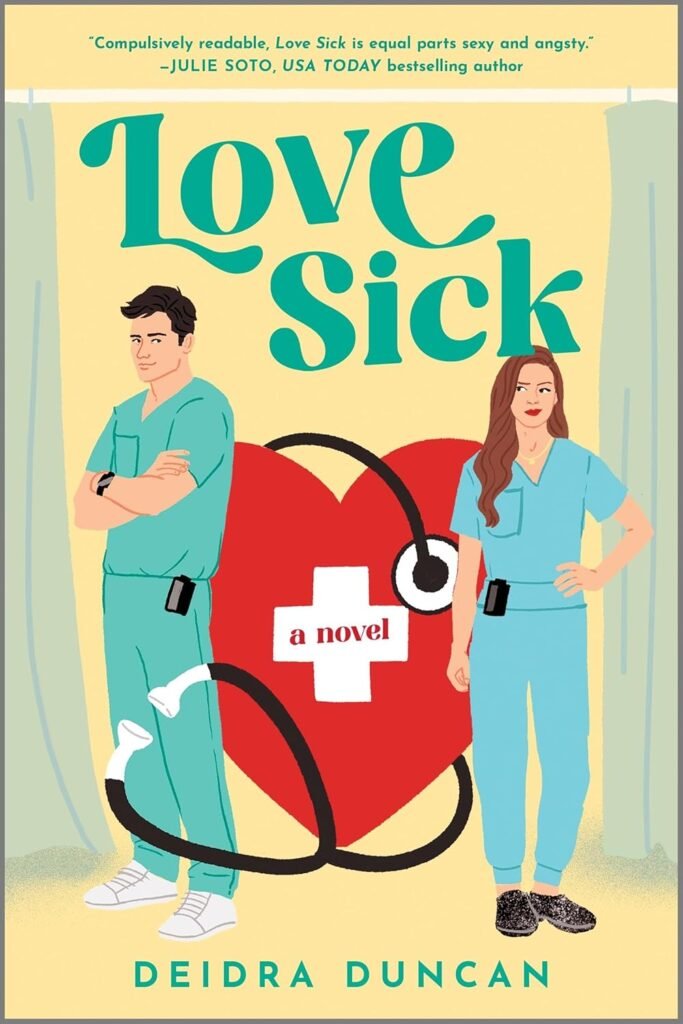
I met my husband, a surgeon, in the last year of his final residency, and for the next fifteen years watched him train residents of his own. I have never, until Love Sick, read a romance that captures that world with such accuracy. As anyone who’s gone through it—or lived with someone who has—knows, residency isn’t just hard; it’s a ritual of endurance, a brutal process that shapes doctors to withstand the worst and still show up. You have to be almost superhuman, able to heal on a dime, and composed under pressure that would flatten most of us. It’s a world of bullying attendings, harassing administrators, irritated hospitalists, and constant crises. (For better and worse, the system mostly works.) Duncan writes it exactly as it is. This, peeps, is contemporary romance world-building at its very best.
Dr. Grace Rose, newly minted (and brilliant) OB-GYN resident, walks into this pressure cooker and discovers, to her horror, she’s already been Prynned. Before she’s even unpacked, a rumor spreads that she slept her way into the program. This story is invisible and everywhere. What begins as one malicious lie (its origin, revealed near the end, is both dismaying and believable) metastasizes into legend: Grace is a seductress, an opportunist, and, endlessly, a slut. Depressingly, this gossip isn’t confined to those in her program. The medical center’s nurses, techs, and staff pick gleefully at her reputation like it’s communal property. Duncan nails the poisonous complicity of a culture that claims to hate misogyny while feeding on it. Love Sick isn’t just about sexism in medicine; it’s about our endless appetite for tearing down successful, competent women. The professional damage is tremendous and the personal cost—to Grace’s sense of self, to her ability to trust anyone—is devastating.
Against that backdrop, Julian Santini—one of her co-residents and, at first, one of the “BrOB-GYNs”—could have been just another dick in scrubs. Instead, he becomes, for both Grace and the reader, a gift. (Julian faces his own prejudices–he’s a DO, a kind of physician many MDs consider lesser, and he struggles with AD/HD.) He’s steady, self-aware, very witty, and, of course, incredibly hot. Their relationship builds slowly and believably, through snark, exhaustion, and palpable chemistry.
The others in Grace and Julian’s residency year—Alesha, Raven, and the fabulous Kai—give the story warmth, humor, and a surplus of charm. Duncan captures the way friendship becomes survival in residency, how humor and booze bond those under stress. Their regular get-togethers, affectionately called Group Therapy, are fueled by a dangerous amount of a drink they call Unicorn Blood (I would love the recipe—that stuff sounds magical). Those scenes, full of Harry Potter jokes and supportive snark, are among the novel’s best.
The novel spans the four years of Grace’s residency—the reader feels the grind, the learning curve, the way getting through the days and nights is often just another test to survive. The romance mirrors that timeline. But, unlike the residency work which moves at a believable and interesting pace, the slow burn relationship between Julian and Grace take too long to flame. Then, horribly, just when their hard-won happiness finally arrives, Grace blows it up. Her reaction is overwrought and wildly unfair to Julian. For them it’s tragic; for the reader, it’s maddening.
Still, Love Sick is an impressive debut: smart, funny, and unflinchingly real about the toll our medical training exacts on its practitioners. The friendships are luminous, the hospital politics razor-sharp, and the love story, for much of the book, is a good one. Duncan is an excellent writer who nails both empathy and anger. Her jokes land and her insights resonate.
My diagnosis: Love Sick, though not quite a DIK–it’s marred by its weak third act and too-pat epilogue–is a worthy, vivid, and often delightful romance. I look forward to whatever Dr. Duncan—she is indeed a Board-Certified OB/GYN—writes next.