
My Antonia by Willa Cather
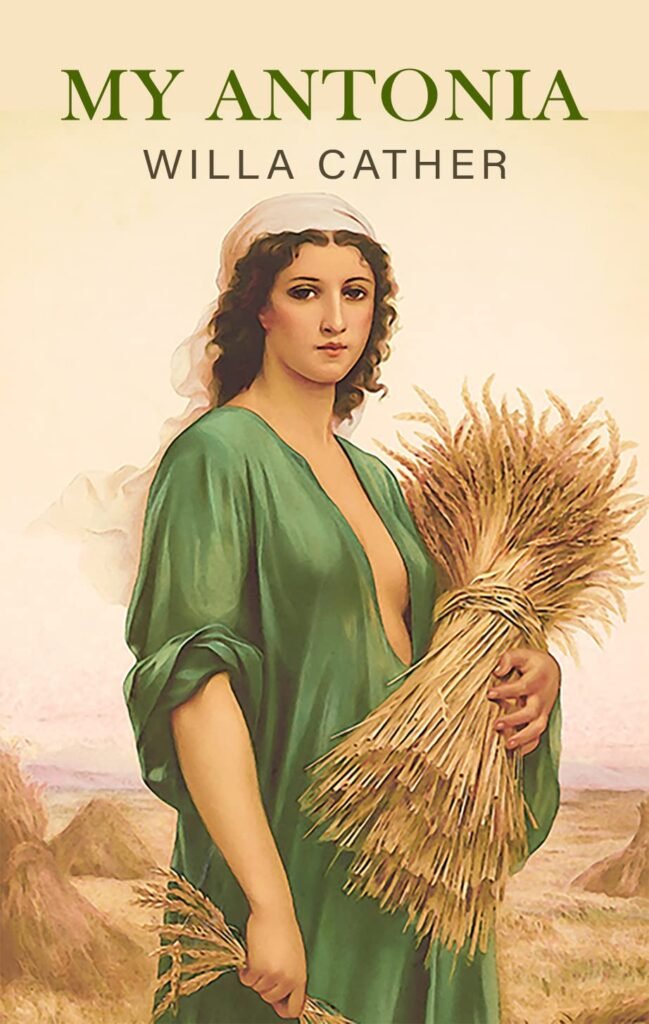
Somehow I’d never read Willa Cather’s My Ántonia. Fortunately, it was my read and be happy book club’s choice this month. Now I know why the book is so famous: My Ántonia is a masterpiece and deserves its place as a great American novel.
The book is framed as a memoir. Jim Burden, now grown, writes about his childhood in rural Nebraska in the latter decades of the nineteenth century, and especially about a girl he knew there: Ántonia Shimerda. Jim begins his story when he is ten, arriving—after both his parents’ deaths—at his grandparents’ farm on the prairie. On his train is the Shimerda family, Bohemian immigrants newly landed in America, and the oldest girl in the family, Ántonia, catches his eye at once.
The Nebraska Jim encounters is vast and unfamiliar. He writes:
As I looked about me I felt that the grass was the country, as the water is the sea. The red of the grass made all the great prairie the color of wine-stains, or of certain seaweeds when they are first washed up. And there was so much motion in it; the whole country seemed, somehow, to be running.
It’s also a place filled with immigrants, families like the Shimerdas, who’ve often unwillingly left their homeland for the American dream. As Jim settles into life on the prairie—the book is an interesting counterpoint to the Little House books which were written about the same period—he meets Swedes, Austrians, Germans, and many others who have come West on the Homestead Act. All are interesting to him, but none so much as Ántonia.
Ántonia, four years older than Jim, becomes his lodestar. She and Jim become best friends, and it’s clear she is the central character of his young life, even if we only ever know her through his nostalgia. What we learn of her is impressive: she masters English quickly, works hard, laughs easily, and is loyal to her struggling family. As Jim and Ántonia age—much of the book takes place from when Jim is ten to eighteen—the differences between them, created by class and nationality of origin, become clear. Jim is educated and pulled toward another life; Ántonia remains bound to the land and her family. And yet the two are never fully divided. They are bound in the way we are with our oldest friends: forever.
Around them, the larger tale of America in the era of Westward Expansion unfolds. It’s a story of land, community, and immigration. Over the years, the families who come to America with nothing work hard, struggle, endure, and often prosper. They have children they dream for, and when disaster comes—as it often does—their neighbors step in to help. The novel is not sentimental about this. Life on the prairie is harsh, and not everyone is rewarded. But the book insists on the power of human loyalty, of community, and of people building something out of almost nothing.
There is much to love about this novel. Cather’s writing is so vivid and irreducible that finishing the book felt like leaving a time and place I’d come to love. My Ántonia made me long for my own childhood, for the years spent running through forests, reading by flashlight, and trusting that, yes, America was a place where I, and others, could succeed. And it reminded me too that nostalgia is its own kind of truth: not always accurate, but always instructive.
I can’t recommend it enough.