
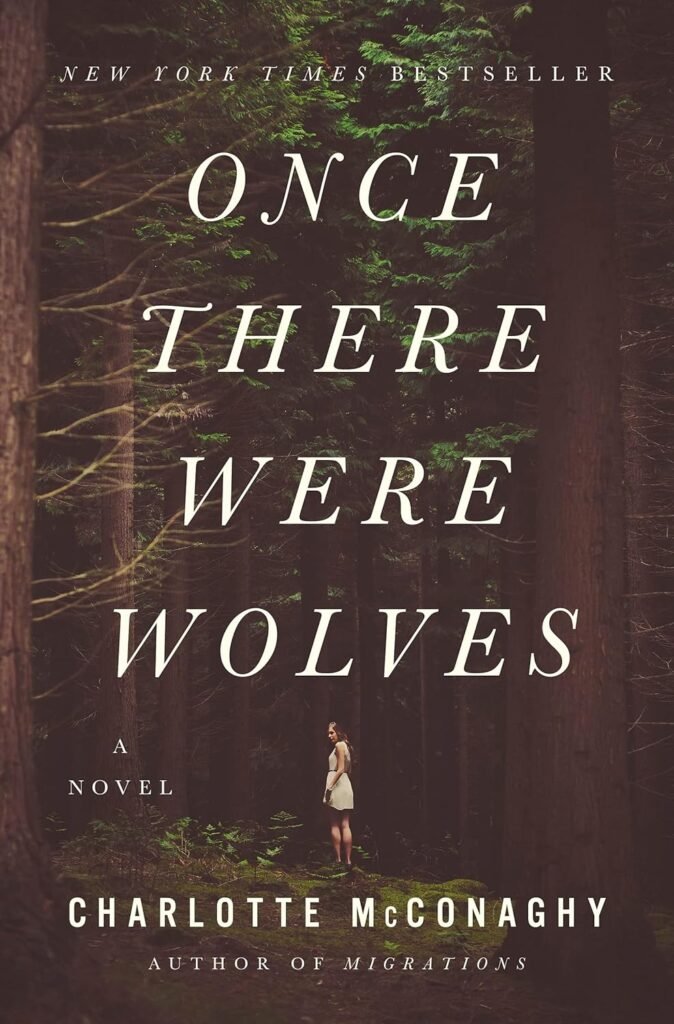
Once There Were Wolves by Charlotte McConaghy
Charlotte McConaghy’s Wild Dark Shore is one of my favorite reads of the last few years. It is the third of three books by McConaghy; Once There Were Wolves is the second. All three books are shaped by climate change. In an interview, McConaghy said:
Each of my novels takes a look at the wildness both beyond us and within us, but they do so through a different emotional lens. Migrations came from a starting point of sadness and loss, Wolves started from a place of rage. Wild Dark Shore is about fear. Fear of how perilous the world grows, fear of the future we are facing, fear of the life we are leaving to our children, and how we are going to keep them safe. Ultimately, I think it’s an exploration of how we love in the face of this fear, in the face of loss.
Once There Were Wolves is full of rage. Almost everyone in this book has been profoundly damaged by the acts of venal, selfish, wasteful people, most of whom were men. The novel isn’t an easy read—one plotline is horrific—but, like Wild Dark Shore, it ultimately is a paean to love: love for humans, love for wolves, and, most of all, love for this earth.
The novel follows Inti Flynn, a wolf biologist brought from Alaska to the Scottish Highlands (Cairngorms region) to oversee the reintroduction of gray wolves into the latter. This effort, Inti tells us, will begin to repair the damage caused when, in the 1600s, the Scots killed every wolf they could find in order to protect their sheep. Without wolves, however, the deer populations exploded, which in turn caused the forests to die. Now, the land needs to be reforested, and the best way to do that is to bring back the wolf. This is a solution well grounded in the science, but despite its benefits, the local population is, almost to a person, sure that the wolves present far too much danger to their herds and homes.
Inti is one of the most unusual leads I’ve read. She has mirror-touch synesthesia, a condition that causes her to physically feel the sensations of others, including animals. In some ways, this makes her more empathetic—especially to the wolves—but it also comes at a cost: she must guard herself against connecting with others so that she is not completely overwhelmed by emotions. This is the rare story where empathy is as deadly as it is necessary, and McConaghy deploys this metaphor brilliantly in the novel’s interwoven stories.
Inti and her team, against the wishes of the native Scots, introduce several packs of wolves into the Highlands. But within days, a notoriously abusive sheep farmer is found dead, his throat ripped out. At first, the wolves are blamed, but then suspicion also falls on several possible human culprits, including the dead man’s wife and her rumored lover, the local police chief, a man Inti herself is drawn to. All the characters here, including the wolves, are complex, and most are hiding secrets. The answer to who the killer is was, to me, marvelously unexpected even as it is, in retrospect, unavoidable.
As much as I enjoyed the mystery, the strongest part of the novel is the wolves themselves. The depiction of wolf behavior and pack dynamics is convincing and, based on my cursory research, accurate. By the novel’s end, I understood why wolves matter—not symbolically, but practically. Rewilding may have its costs, but without predators, our ecosystems cannot thrive.
Once There Were Wolves is gorgeously written, and reading it was absorbing. Once I’d finished it, however, I could see its flaws. The setting, as well as the people themselves, are less convincingly written than the wolves. Its message—we must live with nature if we want to live—is weighty and, in places, overdone. Still, I’m glad I read it, rage and all. It’s not the revelation Wild Dark Shore is—few books are—but it’s a worthwhile, thoughtful read.