The Duke Gets Even
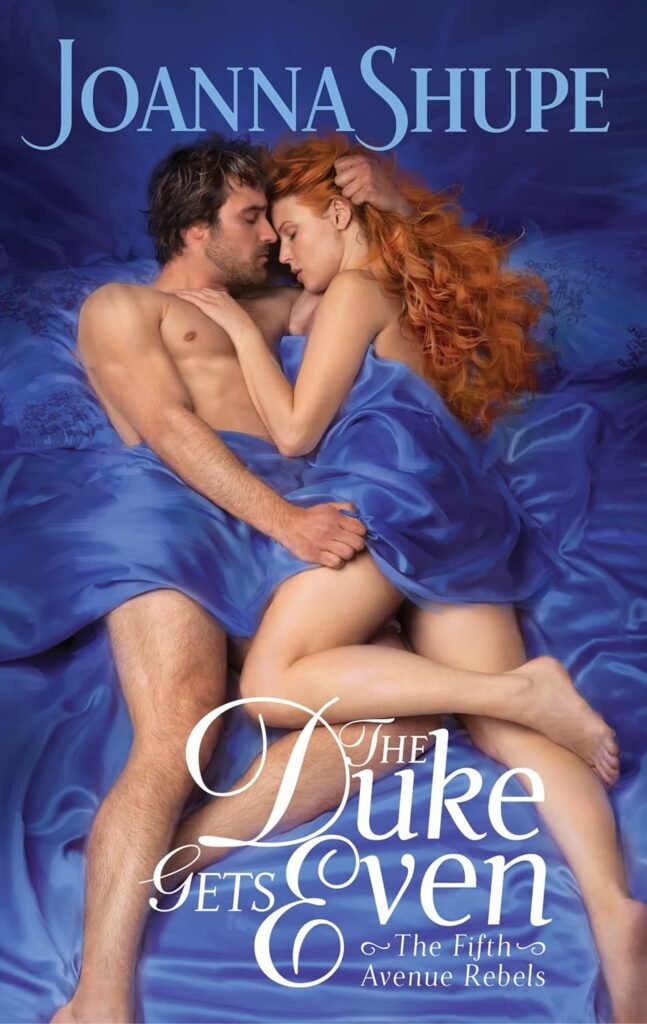
Sigh. The Duke Gets Even is a disappointment. Despite its potentially rich Gilded Age setting and possibly interesting protagonists—a Duke and a crusading activist—this novel fails to deliver. The romance, which should be the heart of the story, is overshadowed by an implausible plot, and the writing lacks the finesse evident in Shupe’s earlier works, such as A Daring Arrangement. Worst of all, it’s dull.
We begin with our hero, one Andrew Talbot, the eighth Duke of Lockwood, seeking to restore his family’s fortunes by securing a wealthy bride in America. After a series of predictably failed proposals, he finds himself at a house party where he encounters Nellie during a midnight swim, leading to, to this reader, an exceedingly trying tryst.
Nellie is a carelessly rebellious heroine, a woman who defies societal norms to the point of absurdity. Her friendships and her relationships with her family don’t mean much to her, at least not compared to her excursions into Hell’s Kitchen where she distributes contraceptives and lectures women about what should be their rights. This strains credulity. Nellie–and the author–seem determined to insert modern feminist themes into a Gilded Age narrative. This wouldn’t be such a problem but Shupe does it in ways that make little sense. It doesn’t help that Nellie is self-absorbed and uninformed. I guess she’s supposed to be admirable, but, mostly, I felt she was a brat.
Lockwood, our brooding Duke, is conveniently progressive, but his possessiveness–Nellie is, of course, gorgeous–is thinly veiled. (For the first part of the novel, I thought he was creepy.) Their romance is listless–they share steamy scenes (Nellie is, of course, completely unconcerned about the consequences of sex) but little else. When they do talk, which they don’t do enough, they speak past each other. They’re the sort of couple I cannot imagine growing old together. I’m still not sure what other than orgasms and a desire to change the world the two genuinely share.
The novel is also bogged down by an excessive number of cameos from characters in earlier books, all of whom are far more interested in Lockwood and Nellie’s tepid romance than I was. Halfway through the book, I considered a nap. I don’t nap.
And then of course, there is the disregard for historical authenticity.
I don’t care, in the way that some others do, that a time period be realistically rendered. But I do care that the world building of a novel makes sense in and of itself. This does not happen here. Nellie’s modern attitudes don’t work in the way they are written against the Gilded Age backdrop. Her character is frustratingly inconsistent. One moment she wants a life of meaning, the next she risks everything for a romantic escapade. The narrative glosses over what could be serious repercussions of her actions, actions which make little sense given her awareness of the limits of the world in which she lives.
Lockwood is also a conundrum. He’s supposed to be very modern in his outlook but his slightly icky pursuit of Nellie, at times, seemed like harassment rather than romance. If I were her, I’d be a bit nervous about the guy.
I really didn’t like this book. And I don’t think most readers of historical romance, or well-written romance will either. Not only is its story completely at odds with its setting, its love story is blah.