
The Rockton series
there are mild spoilers for the first six books in this review


What do I love about the Rockton series?
Imagine a town, created decades ago in the remote Yukon, where people who need to disappear can. This city, Rockton, is cloaked and essentially invisible–there’s no electricity, no computers, phones, or internet, no mail. Rockton only admits people who have a skill the town can use or–and this is something the reader learns over time–who have paid a vast sum to the Council, the shadowy remote group who controls the town. Rockton is in large part self-sustaining and civilized, unlike the areas around it which are peopled by other more primitive groups one of which, the hostiles, are terrifying.
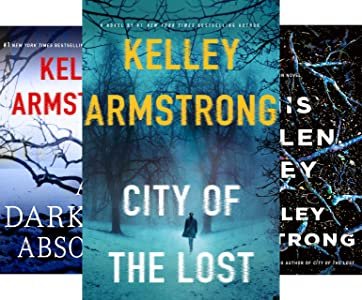
In book one, City of the Lost, a young woman named Casey Duncan comes to Rockton with her friend Diana. Both are escaping violent pasts. Diana, however, hasn’t any real skill to bring to town but Casey does. Rockton has just one sherriff, Eric Dalton and he’s been unable to solve a series of killings that have recently occurred in Rockton. Casey is a homicide detective and is professionally trained, something Eric who was born in Rockton is not.
Over the seven books in the series, Armstrong keeps the suspense and the tension coming. I love good long plot arcs and this series has many. Who are the hostiles and why are they so violent? What is the true story behind Dalton’s childhood? Who is the Council and what are their motives? Is Rockton made up of criminals, victims, or both? Incorporated into these plotlines, in each book, is a specific mystery, several of which I was riveted by and couldn’t see the denouncements until they arrived upon the page.
Armstrong also excels at character. Rockton is a small place and we get to know many characters, none of whom are quite what they seem. I am especially fond of Isabel, the brothel owner, Mathias, the butcher, and Jacob the, well, I’ll let you learn that on your own. All the books are built upon the relationship between Casey and Dalton which is a romantic suspense reader’s dream.


If you are looking for a smart, addictive, romantic suspense series, the Rockton novels are for you. While not every book in the series is a DIK, the overall experience the series is superb. I recommend it highly.