
The Ruin of a Rogue
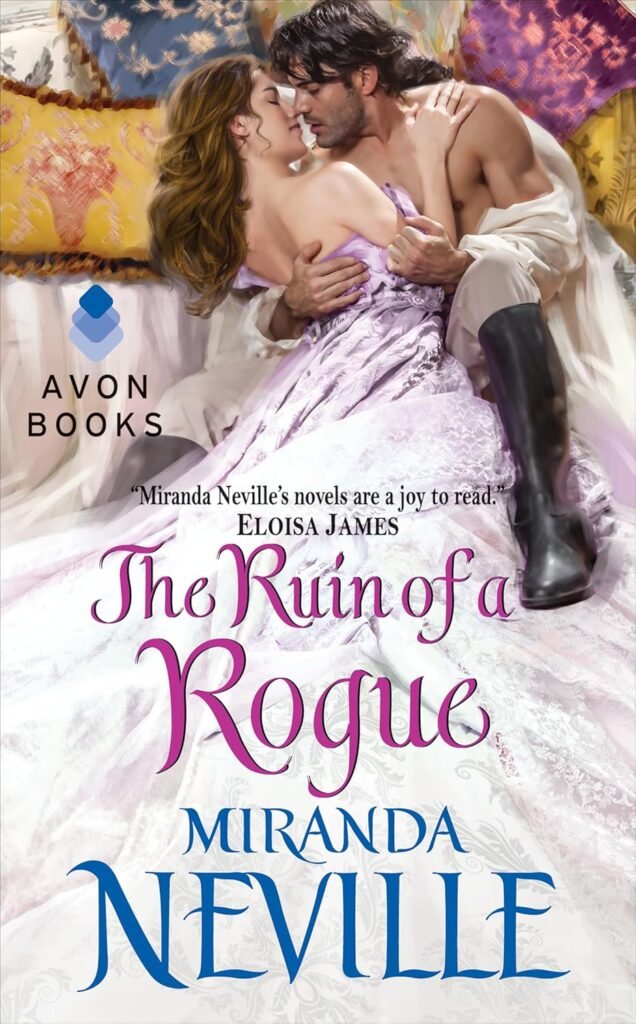
Gertrude Stein famously wrote “a rose is a rose is a rose.” The plot in Ms. Neville’s latest in her The Wild Quartet series, The Ruin of a Rogue, may be summed up as: A rogue is kinda a rogue is a non-rogue. I’ve never been wowed by the poetry of Ms. Stein and I’m wasn’t wowed by The Ruin of a Rogue.
Marcus Lithgow is known as a knavish rogue who makes and loses his living gambling. He’s currently alarmingly broke and in need of funds. He’s previously met Anne Brotherton, “the wealthiest woman in Great Britain,” and decides to set his sights on her. He’ll try to ruin her. He wins if she must wed him – he’d control her fortune – and he wins if her notoriously stern guardian pays him to leave her alone. He’ll flatter the rather unremarkable Miss Brotherton, persuade her to let him lead her astray, and put his losing streak to an end.
Anne is in need of being swept off her feet. She is beleaguered by suitors who are “attracted by her rolling acres, magnificent mansions, and thousands upon thousands of pounds in the funds” and who haven’t the slightest interest in her. Nor do they share her passion for Roman antiquities. They, and the rest of the ton, blanch when she shares her deepest desire is to archaeologically discover an ancient Roman villa buried somewhere in England.
Marcus has done his homework so when he first encounters her, at a meeting he has carefully arranged, he speaks to her of his travels to Rome and his knowledge of ancient statuary. The second time he meets her, again at his contrivance, he woos her with talk of books of ancient times. The third time, he sweetly kisses her and then tells her he’s a cad for doing so when he knows he’s unworthy of her. Anne is smitten…until she overhears Marcus talking with her neighbor, the Duke of Denford, with whom Marcus attended Oxford. Julian asks Marcus how he is doing in his pursuit of Anne and her money.
“Spoiled heiresses need careful handling,” he said. “I believe I progress with the amiable Miss Brotherton. The poor girl is beginning to trust me. Two steps forward and one back. You know how the game is played. I kiss her, and apologize for the liberty. Next time I shall declare myself unable to resist her. It won’t be long until she’s begging for my attentions. As long as her guardian stays away for a few more weeks I’m confident I can bring home the prize.”
Anne is first crushed and then furious. She’ll teach him to call her a spoiled heiress!
Thus begins Anne’s torment of Marcus. She makes him spend money on her, asks him for absurd favors, and, whenever she is with him, behaves like an excessively entitled harridan. Marcus begins to dread her company and is thrilled to learn he has inherited his uncle’s estate, Hinton Manor, a run down place Marcus hopes to be able to sell for enough coin to refill his very empty pockets. He bids her adieu and hopes he’s seen the last of the bothersome Miss Brotherton.
Anne, though, has heard Marcus’s new found land is a perfect place for excavation; his uncle discovered two Roman villas on the property. She concocts a scheme with a friend and then hastens to Hinton Manor where she plans to harass Marcus into allowing her to explore his land. Displeased to see her, Marcus tells her she’s not taking a single shovel to his property. She pleads and he, thinking it’s vastly amusing, says she can do so only if she agrees to come to his house every morning and spend a couple hours as his housemaid. (He hasn’t any help because the villagers think the Manor is haunted and refuse to work there.) At first she flounces away in indignation but, after thinking about how very much she wants to dig for a villa, she tells him she’ll do it.
The expected happens. As the two spend time together, Anne drops her total brat act and Marcus reveals himself to be an admirable stand up guy.
All of this is written is lovely, detailed prose – perhaps too much prose – but nothing about it pulled me in. I found Anne very difficult to like and even a bit dull. Marcus is a bore as a rake and though he became more complex as he struggled to save Hinton Manor and his moral center, he remained at a remove for me. I couldn’t get invested in whether or not amateur archaeologist Anne found remnants of Rome. I liked watching Marcus care for his tenants, but there was nothing new or striking in the way he did so. I did believe Anne and Marcus could love one another but I didn’t care.
The most interesting thing in The Ruin of a Rogue is the relationship between Julian, the Duke of Denford, and Anne’s married friend Cynthia, Lady Windermere. Cynthia’s husband Damian has abandoned her for reasons unknown and it’s unclear why Julian, who appears to consider Damian a friend, would be pursuing her. Ms. Neville does an excellent job of stoking interest in that story.
The Ruin of a Rogue gets a C+. It’s well-written, but too ponderous and unexciting for me.