To Pleasure a Duke
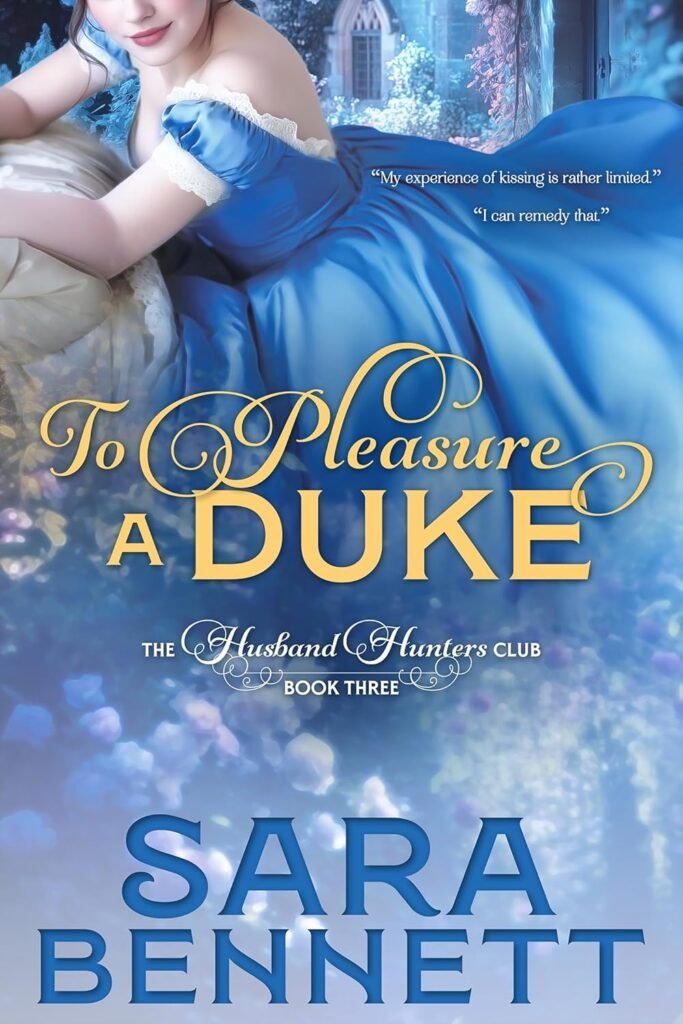
When I was growing up, “Why buy the cow when you can get the milk for free?” was regularly put forth as an argument against premarital sex. This awful phrase has been appearing in English literature since the 17th century. For hundreds of years, those words have described men who want the wanton bang without the wedding bling. These twelve words and the dilemma they describe sum up much of Ms. Bennett’s latest novel To Pleasure a Duke.
Miss Eugenie Belmont belongs, along with several other young women, to the Husband Hunters Club, a group of marriage minded graduates from Miss. Debenhams’s Finishing School. The husband she tells her friends she’s hunting — initially it’s a ruse on her part — is the uber pompous Sinclair St. John, the Duke of Somerton. Somerton, often called the most eligible bachelor in the country, is her neighbor back at home in Gloucestershire and her family is vastly socially inferior to his. The Belmonts are a ramshackle bunch. Eugenie’s father is a trickster; her mother, a flighty emotional ditherer. Her twin brothers are always in trouble; her brother Terry has taken up gambling and speaking rudely. Only her animal whispering younger brother Jack does anything to help Eugenie keep the family on track. The titled Somertons hold not only the Belmonts but virtually every family in England — and thus the world — beneath their notice. They are the cream of the ton and Sinclair, his sister Annabelle, and their mother (the dowager duchess) are utter snobs.
Eugenie has once actually met the haughty Duke. Earlier in the year, while at home, Eugenie and Jack were trying to rid their yard of the family goat. Erik, the goat, had eaten their mother’s best Parisian hat, and was being returned to his original owner, a nearby farmer. As Jack and Eugenie tried to maneuver the recalcitrant goat, they were almost run over by Somerton who was going for an absurdly fast ride on his country roads. After Sinclair made it clear he was THE DUKE OF SOMERTON, he offered to take Erik into his stables. Somerton didn’t do this to be helpful. No – he saw Jack was gifted at working with animals. Somerton thought his livestock would be improved Jack were to come and work at Somerton Hall.
Thus, when back at school and challenged to put a prospective husband up to her fellow husband hunters, Eugenie thinks of the handsome Duke. When she returns to Gloucestershire, she again meets the Duke and, wouldn’t you know it, he’s been thinking about her too. He is drawn to her hoydenish ways and her saucy refusal to behave as though he is her superior. The two begin to flirt and the cow/milk conundrum begins.
Somerton lusts for Eugenie. He’s so desperate to get into her bloomers he’s even willing to make her his mistress. It’s clear to him becoming his mistress would be a great coup for Eugenie. She could warm his bed, offer him pleasant conversation, let him take care of her family’s financial woes, and, best of all, she’d be with him! The Duke of Somerton! What more could any girl want?
The initial answer to that, for Eugenie, is marriage. She doesn’t want to be a mistress; she wants to be a wife, preferably his. Somerton aggressively pursues her, ardently trying to seduce her against her will; once she’s no longer a virgin, it will be easier to talk her into becoming his paramour. Eugenie is equally wild for Sinclair, but, despite her wishes to the contrary, she knows he is so elitist, he’ll never consider her exalted enough to be his spouse.
The two meet secretly; engage in heavy and heavier petting. Sinclair, a prat for the vast majority of the novel, never budges from believing Eugenie belongs in an out-of-the-way love nest rather than at the breakfast table at Somerton Hall. Eugenie is hurt over and over again by Sinclair’s dismissal of her relative worth and she sees him for the arrogant man he truly is. And yet, she loves him, and has a hard time not giving him all the milk he wants.
Woven about Sinclair’s and Eugenie’s machinations is an unexciting subplot involving Eugenie’s brother Terry and his efforts to play the hero for Sinclair’s bratty, self-absorbed sister Annabelle. Terry’s unremarkable and Annabelle is an enfant terrible. Neither they nor their shenanigans were of any interest to me.
Really, not much about the tale appealed to me. Somerton is an ass for most of the story, and who wants to read about an ass for 300 pages? Eugenie is engaging unless she’s with Somerton when she becomes predictable and vaguely masochistic. I didn’t like them as a couple and I’m not convinced happiness is their future. I don’t believe Somerton will ever overcome his oversized sense of self. I suspect, in a few years, he’ll look at Eugenie, curl his lip into its famed sneer, and wonder why he chose her rather than some adoring titled chit from the ton. And Eugenie will realize it’s not giving up your milk too soon that’s the problem. It’s marrying a man capable of seeing you as a lowly cow.