
We Are All Guilty Here
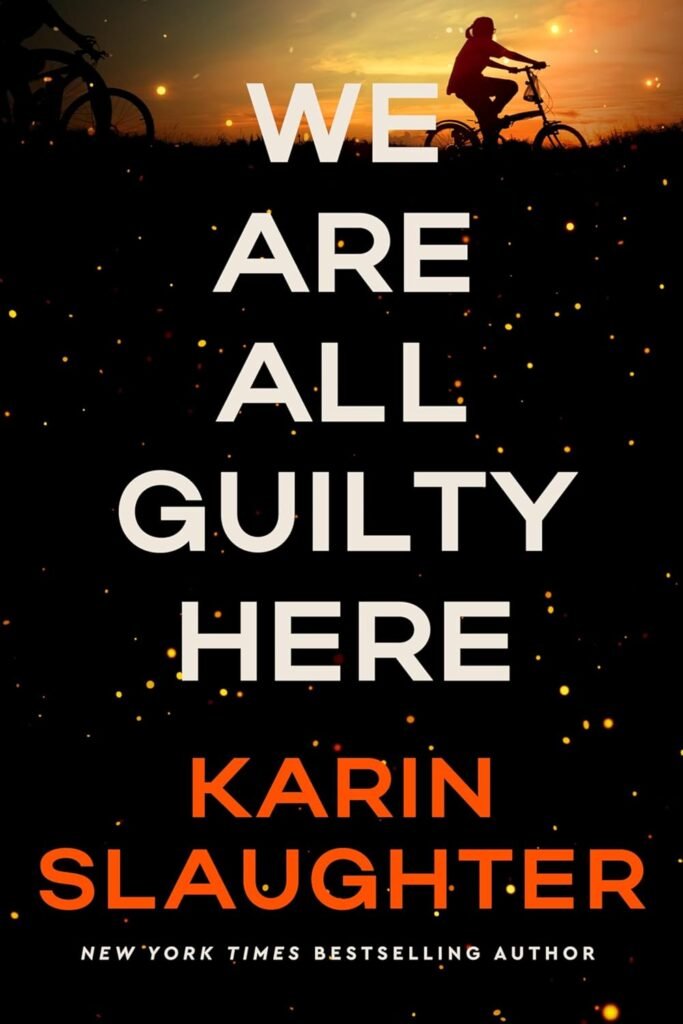
Karin Slaughter’s We Are All Guilty Here opens with a disappearance. Two teenage girls vanish during a Fourth of July celebration in North Falls, Georgia—a town that prides itself on familiarity and tradition. Officer Emmy Clifton is devastated. One of the girls is the stepdaughter of her closest friend, and Emmy is determined to find them before it’s too late.
Emmy is early in her career, working alongside her beloved father, the town’s sheriff. She is also a mother, a sister, a wife in a marriage that is quietly unraveling, and a member of the Clifton family—a long-established clan whose roots in North Falls run deep. Her marriage may be faltering, but her life is full of responsibility and connection. She is shaped by loyalty, instinct, and a steady commitment to doing what’s right. She is not hardened or brittle. She is present, capable, and fully embedded in the world around her. I liked her tremendously.
Slaughter has long excelled at writing strong willed women who, no matter what is thrown their way, survive, even thrive. Emmy is one of her best. In her work life, she’s committed to using the power of the law to help others. In her personal life, she’s a gift to those she loves. Slaughter makes her relatable and real–in fact, all of the characters are vividly limned.
Her parents, George and Myrna, age over the course of the novel in ways that will be immediately recognizable to anyone watching loved ones grow older. Her son Cole, in his twenties, is a standout. He’s such a 20 something and yet, like his mom, is observant, decent, and emotionally steady in a way that matters. Emmy’s friendship with Hannah, her closest confidante, and her relationship with her sister-in-law Celia are equally vivid. These women comfort, challenge, and support each other with a mix of candor and care that feels earned. The Cliftons, as a family, struggle to talk openly about their emotions. They are strong, often quiet, unfailingly loyal, and surprisingly funny. They love without flourish. That limitation becomes a strength. Emmy is not idealized, but she is the kind of person you want nearby when things fall apart.
The Clifton family, in fact, is every bit as compelling as the villains and the havoc they create. Slaughter gives them the kind of layered attention most thrillers reserve for the perpetrators. Their affection is messy and enduring. Their friction feels lived-in. They linger because they are drawn with clarity and warmth.
The novel unfolds in three parts. The first reads like classic Slaughter: girls go missing, predators hide in plain sight, and a town’s surface calm begins to crack. It is grim in places and occasionally familiar. Then the narrative leaps forward twelve years, and the book opens up. Assumptions fracture. Histories shift. One late reveal genuinely startled me—not for its shock value, but because of how fully it reframed what had come before.
The final section, an extended epilogue, is the most affecting. With the case resolved, Slaughter gives her characters time to breathe. After so much violence, the tenderness of these closing chapters is striking. People reach for each other. They find language, however limited, for what they feel. There is grief, but also connection. Slaughter allows love to emerge not as a reward, but as a consequence of survival. I cried.
Jude, the FBI consultant who arrives in the second half, is unforgettable. She is astute, composed, and uninterested in performance. She does not draw attention, but her presence recalibrates every scene she enters. Her competence, insight, and dry humor offer something rare in fiction: a woman entirely unbothered by expectation. More characters like her would be a gift.
This is the first in a series, and that direction feels right. Not every thread is resolved, and several characters—Jude, Dylan, Cole, Millie—are clearly positioned for more to come. The Clifton family alone could sustain multiple books without losing energy.
A few elements falter. There is a medical blind spot late in the novel—something that touches several characters and carries emotional weight—that feels implausible and insufficiently examined. Slaughter is usually meticulous, so the lapse is noticeable. It is not a minor detail, and it weakens an otherwise well-constructed world.
The title also misleads. We Are All Guilty Here suggests sweeping communal complicity that the story does not support. There is, without revealing specifics, some shared culpability, but not at the scale the title implies. It introduces a thematic promise the novel does not fulfill, and distracts from the clarity of the story itself. Slaughter does not need the misdirection. The novel holds up without it.
And, lastly–and maybe this is just me–I was sure who the bad guy was by the third chapter. It didn’t spoil the book for me in part because my suspicions weren’t confirmed until the end. But, thinking about it now, it feels as if it was a little too clear who was pulling the strings.
Still, this is one of Slaughter’s strongest books. It is emotionally textured, precisely plotted, and anchored in relationships that feel alive. It addresses violence, but more powerfully, it explores what endures afterward: the effort of staying connected, the quiet resilience of flawed families, and the slow work of choosing love in the face of failure. This story belongs not only to Emmy, but also to Jude, Cole, Myrna, and the many others Slaughter gives space to grow. Their lives feel unfinished in the best way, and I will follow them wherever the series goes next.