
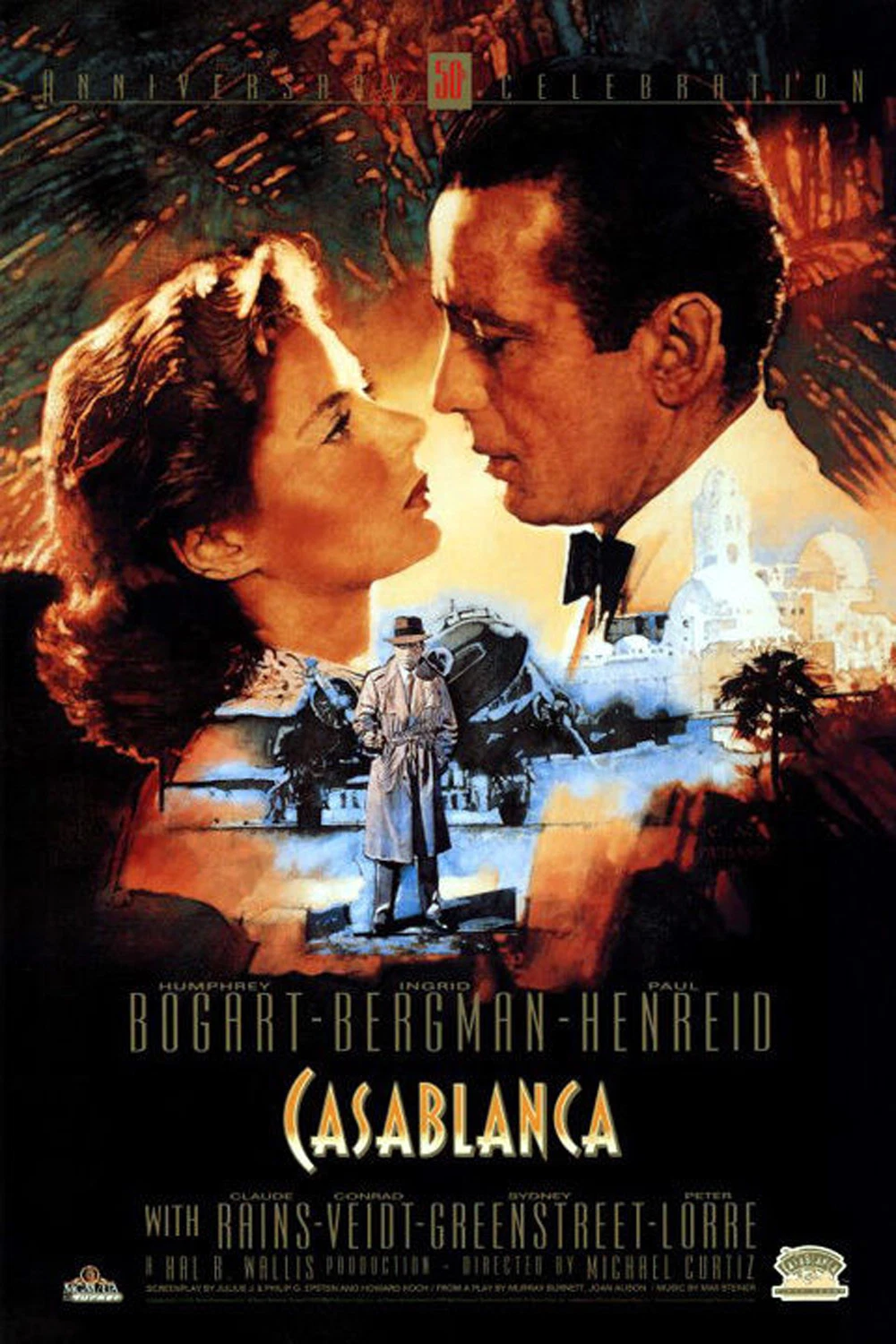
I recently watched Casablanca with my mother and my daughter—three generations of women. I’d seen it before, decades ago. It’s one of my mother’s favorites and my daughter–who picked it–had never seen it. As the final credits rolled, we wiped away our tears and nodded our heads. That, we all agreed, was a phenomenal film.
Casablanca was released in 1942 and was filmed before the US had entered the war. It was a product of the studio system operating at full command of its power. Warner Bros. assembled its A-list cast, handed the script to a team of sharp, fast writers, and gave Michael Curtiz the director’s chair. From the moment it opened, it was recognized for what it was: a film of exceptional craft and emotional weight. It won Oscars for Best Picture, Best Director, and Best Screenplay. It gave both Ingrid Bergman and Humphrey Bogart the defining performances of their careers. And unlike so many films whose glory fades with the times, it has only, justifiably so, grown in stature.
It is not a romance in the genre sense—there is no happy ending—but it is one of the most powerful love stories ever put on screen. Rick and Ilsa are in love. That’s never in question. But the film’s greatness lies in what it does with that certainty. They don’t run away together, and the audience isn’t asked to mourn that choice. The story makes clear that had they stayed together, their love would have curdled under the weight of what they failed to do. They walk away not because they’ve stopped loving each other, but because they still do—and because they understand that some moments call for something larger than personal happiness.
The film never underlines its themes, never lectures. It trusts the viewer to see what’s at stake. It lets the story unfold in a space where wit, sorrow, and clarity coexist. It gives its characters room to be flawed, but never lets them off the hook. When Rick lets Ilsa go, he does it with full awareness of what it costs—and of what it’s worth.
There’s no false nobility here, no convenient villainy. Everyone is compromised and everyone can, and does, do better. It’s in part that movement—from detachment to conviction, from neutrality to action—that gives the film its enduring force.
Casablanca is flawless. Not because it’s polished within an inch of its life, but because every element—dialogue, structure, performance, pacing—serves the story it’s telling. It’s a film about love, about loss, about war, and about principle, and it never reduces any of those to a cheap take.
I miss films like this—gorgeous, moving, aspirational stories where plot, character, and setting seamlessly come together—and I have to ask: do you? Have you seen Casablanca? What are your thoughts? And what other films, if any, still carry this kind of wonder?




There’s no doubt in my mind that Casablanca is, quite simply, one of the best films ever made. It’s heartbreaking, and it’s downright funny at times (Renault: “I’m shocked! Shocked to find that gambling is going on in here!” Croupier: “Your winnings, sir.”) What makes it so special for me is the dialogue – it’s witty, it’s poignant and it’s perfectly delivered – they really don’t write ’em like that any more.
The casting is perfect – it always amazes me that neither Bogart nor Bergman were actually the first choice for their roles (Ronald Regan and (I think) Hedy Lamarr were) – Paul Heinreid brings a real depth to Lazlo, who otherwise could have come off as a bit cold and martyr-ish, and Claude Rains steals pretty much every scene he’s in; Renault’s tenuously balanced (bromance) relationship with Rick is perfectly judged.
As to Rick and Ilsa… Bergman is lumunous, Bogart is such a wonderful anti-hero, but honestly it’s hard to see how the film could end in any other way than it does. And it’s perfect.
I agree with all of this!
Now I want to watch To Have and Have Not.
Bacall wasn’t luminous as much as mesmerizing and it is, of course, the film in which the Bogie and Bacall romance began. Plus, this scene!!!
https://www.youtube.com/watch?v=30DSfAA0brs
Another great choice! I could watch these kinds of oldies all day and never get tired. What always strikes me is the quality of the dialogue and the seemingly instinctual way it was delivered, especially in screwball comedies. I remember the first time I watched His Girl Friday I felt l like I was holding my breath because it was so fast and witty I didn’t want to miss any of it!
His Girl Friday is so clever!
If you go a decade earlier, there was It happened One Night with that unforgettable hitchhiking scrne.
And the walls of Jericho! 😉
Yes, this is another great film. And the trumpet tearing down the walls of Jericho at the end was so funny.
Try Key Largo, another pairing of Bogart and Bacall, along with Lionel Barrymore, Edward G. Robinson, and Claire Trevor. There is also a young Jay Silverheels, before he became famous as Tonto in the Lone Ranger.
I like Key Largo–I am a big old movie watcher!
There is some other post I’ll write about my favorite old movies!
THAT list would include:
A Letter to Three to Wives
Rear Window
All About Eve
The Best Years of our Lives
From Here to Eternity
I love All About Eve and A Letter to Three Wives!
The latter is virtually unknown today and it is phenomenal. That era of film was so much better for women in many ways.
I love A Letter to Three Wives. TCM usually plays it at least a couple times a year.
I haven’t seen it in years but I remember thinking it was fabulous.
All About Eve is a great movie snd one of my all-time favorites
Casablanca is a classic for a reason; not my absolute favorite classic film, but I do enjoy it!
I’m not sure what my favorite classic film is because the word classic always throws me. Is A New Hope a classic? Return of the King? The Blues Brothers?
The term is often applied to films up through the 60s which rules out all of those. It’s a very subjective term!
The Blues Brothers and Blazing Saddles still make me laugh. Baked beans anyone?
Mine’s What a Way to Go!
I can never watch “Casablanca” without tears, especially in the duel between the Nazi anthem and “La Marseillaise.” What makes it even more touching is that everyone there–the woman playing the guitar, the Nazi officer, the woman considering sleeping with a man not her husband to raise the money, Peter Lorre, Ingrid Bergman, Claude Rains—were all from other countries, all over Europe.
Hollywood in the thirties was a refuge for Jews and others, fleeing the Nazis. The united and each donated a substantial amount of their salaries (I think I read one-third) to bring more people over. These people, many from Germany which had the most sophisticated movie studio (UFA), breathed new life into Hollywood. You might have seen the movie classics made in German: “M” about a child killer (Peter Lorre), “Metropolis” (a science fiction), Marlene Dietrich in “The Blue Angel” which allowed her director and her to come to Hollywood.
Bergman said that “Casablanca’s” script was being written as they filmed, and that they didn’t know how it would end—whether Elsa would go with Bogart or stay with her husband.
I don’t think Hollywood remembers how to make a good love story, anymore. I read a movie critic who said that love stories always end unhappily, but only rom coms end well. I think he was right; it’s the unhappy love stories that we remember the most.
Hollywood is putting out violent, comic book movies because most of their box office comes from overseas, so eliminating dialogue is smart. It just prevents movies from being any good.
Yes, the dueling anthems scene always makes me tear up too. And the fact that when it was made, no one—not the audience and not the film makers—knew how the war was going to end. But the call to self-sacrifice still resonates.
Do you know that the cast had no idea how the movie would end until the last scene was shot? That is part of why all the lead actors have so much nuance in their roles.
I love that scene – and add to the list of refugees composer Max Steiner (who wrote the original score), who, along with Erich von Korngold, wrote some of the finest film scores ever.
I tend to find some films from the 1940s and 1950s a bit “stilted” and so out of date that I often pay more attention to all of the men wearing hats (even indoors), everyone smoking, over-plucked eyebrows on the women and the often very bad sets though costumes could be marvelous. Having said that, I agree that Casablanca is a classic though not my all time favourite film. I guess if I had to put one or two forward for personal DIKs they would be Barry Lyndon and Tom Jones. I love both of them for the sheer beauty of the production values but also the humour, pathos and the actors who brought both films to life for me. Who can forget Albert Finney and Joyce Redman in that famous “eating scene”. That’s a classic scene for me!
I love “Casablanca” and old movies in general. Some of my all-time favorite rom-coms are black-and-white classics like “Sabrina,” “The Philadelphia Story,” and “It Happened One Night.” I think that, because these films couldn’t rely on high-tech special effects and explosions, they had to pay more attention to things like characterization and dialogue. To me, the fact that many of these movies look more like stage plays (not a lot of fancy camera angles, close-ups, and the like) is a feature, not a bug.
The Philadelphia Story is one of my favourites, too – such a great cast. And only hearing the title Bringing Up Baby has me & Mr Caz starting to sing “I can’t give you anything but love… Baby”!
Casablanca is not my favorite movie—I watched it once and wondered what the hype was all about. It was just a melodrama cloaked up in patriotic hues. And Bogart was okay —he would do much better movies later on and I personally think his best is Caine Mutiny and he was not even a hero in that movie. If I were to select a romantic movie in that period it would be Roman Holiday—it is not melodramatic but it is poignant and your heart aches with the thought that this romance can never blossom.
Good love stories are still made (I am not talking about meet-cute romances)—Past Lives by Celine Song is a quiet, thoughtful drama about love that lasts for more than thirty years but becomes painfully one-sided. Song has produced another one this year called Materialists which has received excellent reviews (I have not seen it yet).
The only thing I liked about Casablanca was the song and that too as it was used in Judy Dench’s tv comedy As Time Goes By.
One could almost say the true romance in the movie is between Rick and Renault. Their bromance is part of what makes the movie so special. Several years ago, I read the book “We’ll Always Have Casablanca” by Noah Isenberg on the making of the movie. The original script was meant to be a play and was inspired by the scriptwriter and his wife’s route back to the US after they visited relatives in Austria for their honeymoon. They were Jewish and the Anschluss happened while they were there, so they were unable to go directly home. They took a circuitous route through Portugal. While waiting around to take the final flight out of Lisbon, they hung out at a bar with a lot of other refugees waiting to catch a flight. Hollywood noticed the script and put a pair of genius scriptwriters on the job to flesh out the original script. The character of Ilsa was originally more of a “working girl”.
As someone else mentioned, the majority of the cast, both major and minor characters, were European refugees, many were Jewish. I wouldn’t say Ingrid Bergman, Sidney Greenstreet, and Claude Rains were as they were well established in Hollywood by that time or came over to pursue work in Hollywood. But Paul Henreid, S.Z. “Cuddles” Sakall, Peter Lorre, and Conrad Veidt were all political refugees as well as almost all secondary characters. Conrad Veidt had been a major German film star. He wasn’t Jewish himself, but his wife was.
The story itself is full of plot holes, but what makes the movie so great is the dialog and the acting. It is chock full of memorable lines, my favorites being “Round up the usual suspects” and “ Louis, I think this is the beginning of a beautiful friendship.” The line “ Play it again Sam” is not actually said in the movie, but thanks to Woody Allen most people think it is. I’ll watch this movie every time it airs just to hear the lines.
This TBH
Bachelor Mother with David Niven and Ginger Rogers is one of my favorite movies of the black and white era. Charade with Audrey Hepburn and Cary Grant is another great one. The 1958 film The Matchmaker with Shirley Booth and Shirley MacLaine.
Casablanca’s ending was unearned and unreasonable. Patriarchal, “Don’t worry your head dearie, I know better than you.” crap.
I still love my… I think it is about 27m or romantic highlights and the La Marseillaise scene is one of the most stirring ever filmed.
I don’t see it that way–I think Rick is making the right decision for him. Yes, he tells her it’s right for her to, but, ultimately Rick knows he’d never be at ease if he didn’t put Lazlo’s work first.
I love Casablanca. As others have mentioned, there’s real poignance knowing that so many of the actors didn’t merely play refugees in the film, they were refugees.
I think the black and white photography added to the atmosphere and tension that is so palpable. It’s a bit of genius that we hear about Rick long before we see him, and even in the first scene where he appears we don’t see his face initially, as the camera slowly climbs up from the desk to his hands and then, finally, his face. Bogart wasn’t handsome, but he could be compelling.